The staircase had been the dividing line for eight months before anyone said it out loud. The bedroom was upstairs. The bathroom was upstairs. But navigating those 14 steps had become something she planned around -going up in the morning, staying up until dinner, coming down once, and not going back. Her son visited one weekend and found his mother had been sleeping on the living room sofa for three weeks because the stairs had quietly become too much.
Stairlifts for seniors are one of the most life-changing home modifications available, and one of the most frequently delayed. They are delayed because they seem expensive, because selecting one feels complicated, and because many older adults associate them with a loss of independence rather than an extension of it.
This guide changes that. By the end, you’ll understand the types of stairlifts for seniors and how they work, what each configuration costs in the US market, the key criteria for how to choose the right stairlift for your specific staircase and mobility needs, and what the installation process actually looks like. Whether you’re deciding for yourself or helping a parent, you’ll finish this guide ready to act.
What Stairlifts Are and Why They Matter for Aging in Place
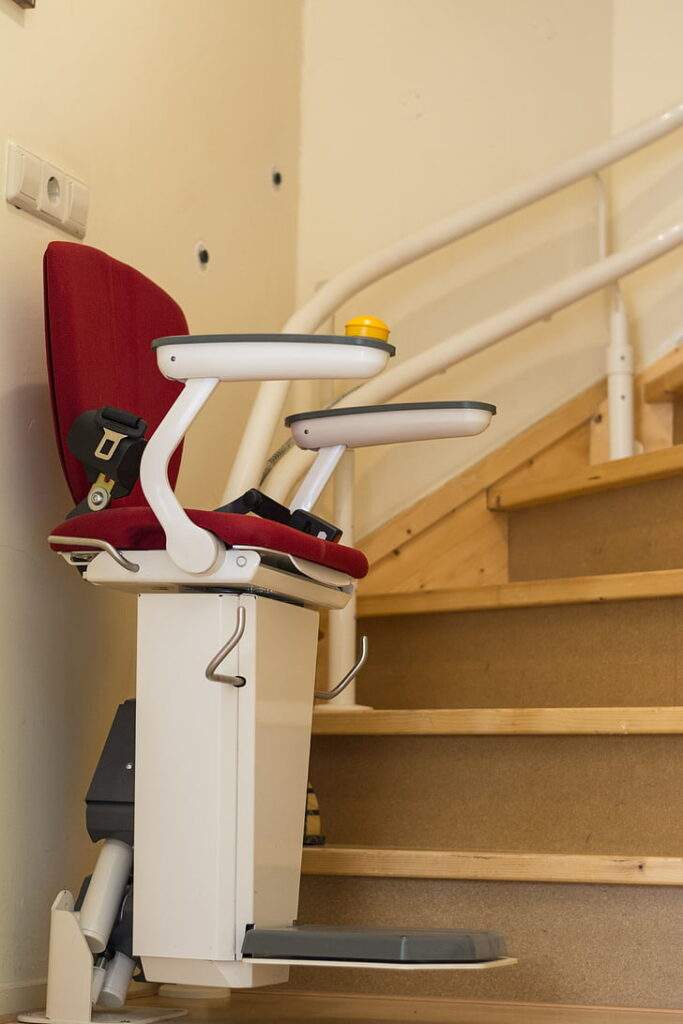
A stairlift, also called a chair lift, stair glider, or stair chair lift, is a motorized chair that travels along a rail mounted to the staircase, carrying the user between floors without requiring them to climb or descend the stairs independently. The user sits in the chair, secures a seatbelt, and uses a joystick or rocker switch to control the movement up or down.
Stairlifts do not replace the stairs. The staircase remains fully functional for other household members. The stairlift simply adds a powered transport option alongside the existing stairs.
For seniors who can no longer safely navigate stairs due to arthritis, joint replacement, Parkinson’s disease, COPD, heart failure, or any condition that affects lower-limb strength or cardiovascular endurance, a stairlift for seniors is often the difference between a home that can be fully used and one that effectively becomes a single-floor apartment.
According to AARP’s 2024 Home and Community Preferences Survey, 75% of adults 50 and older want to remain in their current home as they age. For the significant proportion of adults whose homes are multi-story, the staircase is the most common structural barrier to achieving that goal.
The cost of stairlifts for seniors at home is frequently cited as the reason for delay. That is understandable, as quality stairlifts represent a meaningful investment. But the relevant comparison is not “stairlift cost vs. no stairlift cost.” It is “stairlift cost vs. the cost of relocating to a single-story home, an assisted living facility, or moving in with family.” Framed that way, the economics look very different.
For the complete guide to aging-in-place home planning covering bathroom, bedroom, kitchen, and entryway modifications alongside staircase accessibility, see our comprehensive guide to aging in place.
Types of Stairlifts for Seniors and How They Work
Understanding the types of stairlifts for seniors and how they work is the essential first step, because the configuration of your staircase determines which type is appropriate, and the type you need drives the cost range significantly.
Straight Stairlift: The Most Common and Most Affordable Type
A straight stairlift is designed for a staircase that runs in a single, uninterrupted line from bottom to top, with no curves, turns, or intermediate landings. This is the most common staircase configuration in American homes and the configuration that produces the most straightforward installation.
How it works: A straight aluminum rail is mounted to the stair treads (not the wall) using brackets. The chair assembly clips onto the rail and travels its full length on a motorized drive system. The chair folds up when not in use, preserving stair access for other household members. Controls include a joystick on the armrest, wireless remote controls for calling the lift from either floor, and obstruction sensors that stop the chair automatically if anything is in its path.
Installation: A straight stairlift can typically be installed in 2–4 hours by a trained technician. The rail is pre-cut to the staircase measurement taken during a pre-installation survey. No permanent structural modification to the home is required as the mounting brackets attach to stair treads and can be removed without damage.
Best for seniors with limited mobility: This is the configuration that works for most residential staircase situations and the starting point for any stairlift evaluation.
Cost of stairlifts for seniors: straight configuration: $2,500–$5,500 fully installed, including the unit, rail, and professional installation. Refurbished or reconditioned straight stairlifts are available from many suppliers for $1,500–$3,000 installed, which is a legitimate cost-reduction option when the budget is a constraint.
Curved Stairlift: For Staircases With Turns, Landings, or Spirals
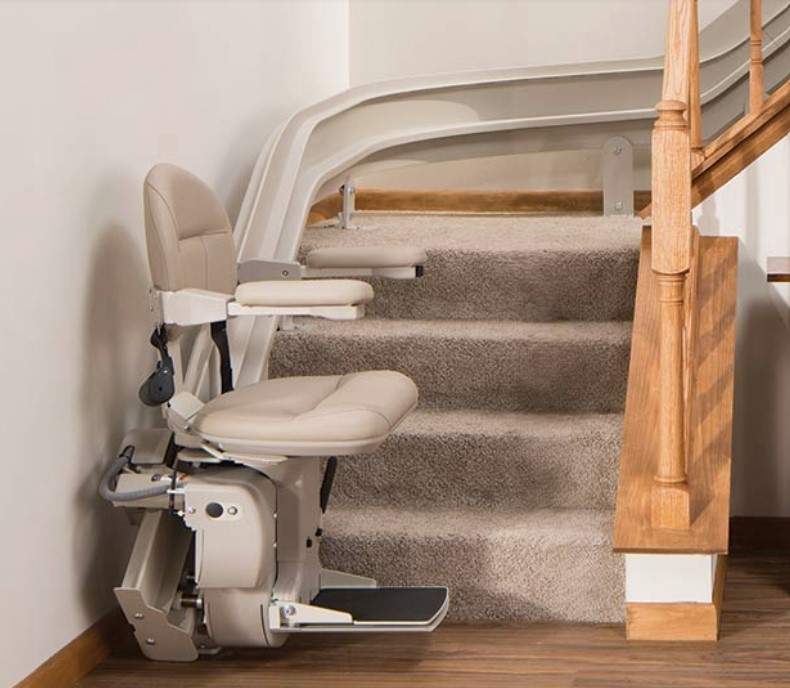
A curved stairlift is required for any staircase that changes direction, like a staircase with a 90-degree turn at a landing, a 180-degree switchback, or a curved or spiral design. Curved stairlifts are mechanically similar to straight models but require a custom-bent rail manufactured specifically for the measurements of the individual staircase.
How it works: A technician measures every dimension of the staircase – each tread, riser, turn radius, landing width, and endpoint – and those measurements are used to manufacture a continuous curved rail that follows the staircase’s exact path. The chair travels this custom rail through every turn. Because no two curved staircases are identical, no curved stairlift is interchangeable between homes.
The key implication of custom manufacturing: Curved stairlifts cannot be reconditioned or resold in the way straight stairlifts can. A curved rail built for one staircase serves exactly one staircase. This is why curved stairlifts cost significantly more and why the reconditioned market for them is limited.
Installation time: 4–8 hours for most curved installations. Some complex spiral configurations require longer.
Cost of curved stairlifts for seniors: $8,000–$15,000 fully installed for most configurations. Premium brands (Bruno, Acorn, Handicare) are at the high end of this range; mid-range brands (Stannah, AmeriGlide) are toward the lower end. Truly complex spiral staircases can exceed $20,000.
Outdoor Stairlift: Weatherproofed for Exterior Steps
An outdoor stairlift is specifically engineered for exterior staircase applications like front porch steps, deck access, and any exterior stair with multiple rises. The mechanical and electronic components are sealed against rain, humidity, temperature extremes, and UV exposure.
Key differences from indoor models:
- Weatherproof motor and control housing
- Stainless steel or powder-coated aluminum rail that resists corrosion
- Seat and armrests made from weather-resistant materials that don’t degrade or become uncomfortable in sun and rain
- Automatic cover for the seat when not in use
Outdoor stairlifts are almost always straight configurations, since exterior staircases rarely curve. The installation process is similar to indoor straight models, but anchoring must account for the specific surface material of outdoor steps (concrete, wood decking, stone).
Cost of outdoor stairlifts for seniors: $3,000–$6,500 fully installed for most exterior stair configurations.
An important alternative to consider: If the exterior staircase has only 2–4 steps, a modular ramp system (covered in our entryway modifications for aging in place guide) may be more cost-effective and provide better all-weather access than an outdoor stairlift. A CAPS professional can evaluate which solution better fits your specific entry.
Perch and Standing Stairlift: For Users Who Cannot Sit
A small subset of users, particularly those with certain hip or knee replacement restrictions, or those whose pain makes sitting at a 90-degree angle difficult, may benefit from a perch stairlift (a semi-standing model with a narrow tilted seat) rather than a standard seated configuration.
Perch lifts require more core stability and upper body engagement than standard stairlifts. They are appropriate for a specific, limited group and should be selected only with OT guidance confirming the user can safely use the perch position for the staircase duration.
Cost: Comparable to standard straight configurations – $2,800–$5,500 installed.
How to Choose the Right Stairlift: Key Decision Criteria
How to choose the right stairlift comes down to seven factors. Each one narrows the decision toward the configuration, features, and brand that best fits your specific situation.
Criterion 1: Your Staircase Configuration
This is the non-negotiable starting point. You cannot choose stairlift type before you know your staircase.
Measure and document:
- Total number of steps and the height of each riser
- Whether the staircase is straight or has any curves, turns, or landings
- The width of the staircase at its narrowest point
- The ceiling height at both the top and bottom of the staircase
- Whether there is a door at the top or bottom that may affect rail end placement
A straight staircase with adequate width gets a straight stairlift. Any turn or curve requires a curved stairlift. An outdoor staircase requires an outdoor model. These are not preference questions; they are functional requirements.
Minimum staircase width: Most standard stairlifts require a minimum of 28–30 inches of clear width (measured between the wall and the opposite banister or wall). Narrower staircases may require a narrower-seat model. So confirm with the specific manufacturer before purchasing.
Criterion 2: Weight Capacity
Standard stairlifts are typically rated for 265–300 lbs. of user weight. For users who exceed this range, bariatric stairlifts rated for 350–500 lbs. are available from most major manufacturers. Bruno, Acorn, and Stannah all offer bariatric configurations.
Weight capacity is a safety specification. A stairlift used beyond its rated capacity is both a safety risk and a warranty void. Confirm the specific model’s rated capacity before purchasing, and do not assume a standard model is adequate without verification.
Cost premium for bariatric configurations: Typically $500–$1,500 above standard model pricing.
Criterion 3: User’s Physical Ability and Transfer Capability
The best stairlifts for seniors with limited mobility are specifically designed around the user’s ability to transfer onto and off the chair independently or with assistance.
Key questions to assess:
- Can the user transfer from standing to seated independently, or is assistance needed?
- Can the user hold the joystick or rocker control and maintain safe grip for the ride duration?
- Does the user have adequate balance to sit safely during the transit without additional lateral support?
- Are there specific seating position limitations (hip replacement angle restrictions, for example) that affect which seat configuration is appropriate?
A licensed occupational therapist (OT) should ideally assess these questions before a stairlift purchase is finalized, particularly for users with complex mobility profiles. The OT assessment ensures the selected model actually matches the user’s functional capabilities, not just the staircase dimensions.
Criterion 4: Seat and Armrest Configuration
Standard stairlift seats are typically 17–18 inches wide, with padded seat and backrest and fold-down armrests. For most users, this is adequate and comfortable. However, several configuration options affect usability for seniors with specific needs:
Swivel seat: Most stairlifts include a seat that swivels to face away from the staircase at the top and bottom landing, allowing the user to stand up from the chair facing the landing floor rather than the staircase. This is a significant safety feature and should be present on any stairlift. Confirm swivel direction before purchase. The seat should swivel toward the landing, not toward the stairs.
Seat height: Higher seat configurations are available from some manufacturers and are particularly useful for users with difficulty with deep seated positions due to hip or knee replacement.
Seat width: Wider seats (up to 21 inches) are available for users who need more lateral space.
Footrest: The footrest should fold automatically (or be easy to operate manually) and should lock flat against the chair when folded to minimize intrusion on the stair tread for other household members.
Criterion 5: Controls and Ease of Operation
For seniors with arthritis, reduced hand strength, or tremors (conditions that affect a significant proportion of stairlift users), control design is a meaningful quality-of-life factor.
Joystick controls (push forward to go up, back to go down) are the most common and most intuitive. Look for a joystick that requires minimal force to activate and hold, as some models require sustained pressure that can be tiring for arthritic hands over a longer staircase.
Rocker switch controls (a simpler two-direction button) are easier to operate for users with significant hand weakness. Several manufacturers offer this as an alternative to the joystick.
Remote controls: All quality stairlifts include at least one wireless remote that allows calling the chair from either floor, so the chair is always on the right floor when needed. Two remotes (one for each floor) is the standard configuration.
Key safety controls to confirm: Obstruction sensors that stop the chair automatically, a safety belt with an easy-operation buckle, and a manual lowering option in case of power failure.
Criterion 6: New vs. Refurbished
A refurbished or reconditioned stairlift is a previously installed unit that has been returned, inspected, mechanically serviced, re-upholstered, and re-certified for installation. Refurbished units are available almost exclusively for straight staircases (since curved rails are custom-built and non-transferable).
The honest assessment: A quality refurbished stairlift from a reputable supplier represents genuine cost savings – typically 30–50% below new pricing – without meaningful compromise in safety or reliability when properly serviced and installed. The key qualifiers are “quality” and “reputable.” A refurbished unit from a supplier who cannot provide service records, a meaningful warranty, and local technician support is not a good deal at any price.
What to require from any refurbished stairlift purchase:
- Written service history of the unit
- Minimum 1-year parts and labor warranty
- Local technician support for ongoing service
- New or like-new upholstery on all contact surfaces
Major national suppliers all offer certified refurbished programs through their dealer networks. This is the safest source for reconditioned units.
Criterion 7: Manufacturer, Dealer, and Service Network
This criterion matters more for stairlifts than almost any other home modification product, because a stairlift that breaks down and cannot be serviced promptly creates a genuine access emergency.
What to evaluate in the service relationship:
- Is there a local authorized dealer and technician within a reasonable service radius of your home?
- What is the typical response time for a service call in your area?
- What does the warranty cover, and for how long? (Industry standard is 2 years parts and labor for new units; some manufacturers offer extended or lifetime motor warranties)
- Does the dealer offer an annual service contract for ongoing maintenance?
Leading manufacturers in the US market: Bruno (US-manufactured, strong dealer network), Acorn (UK-based, wide US distribution), Stannah (UK-based, established US presence), Handicare (European, growing US network), AmeriGlide (US-based, value positioning).
The best stairlift brand for your situation is the one with the strongest local service infrastructure, not necessarily the most prominent name nationally.
Cost of Stairlifts for Seniors: Complete Pricing Guide
Understanding the full cost of stairlifts for seniors at home requires looking beyond the unit price to the total cost of ownership.
New straight stairlift, installed: $2,500–$5,500 New curved stairlift, installed: $8,000–$15,000+ New outdoor stairlift, installed: $3,000–$6,500 Refurbished straight stairlift, installed: $1,500–$3,000 Annual service contract (optional): $150–$350/year
Factors that increase cost:
- Longer staircases (more rail required)
- Bariatric weight capacity
- Premium finishes or upholstery
- Remote controls beyond the standard two
- Folding rail at bottom (allows door to clear the rail end)
- Installation challenges (narrow staircase, unusual configuration)
What Medicare and Insurance Cover
Original Medicare (Parts A and B) does not cover stairlifts – they are classified as home modifications rather than durable medical equipment. This is one of the most common misconceptions among seniors researching this purchase.
Medicare Advantage (Part C) plans vary. Some plans include a home modification benefit that covers stairlifts up to a specified amount, typically $500–$1,500. Contact your specific plan directly and ask explicitly: “Does my plan include a home modification benefit, and does it cover stairlift installation?”
Veterans Benefits: Veterans may qualify for the Specially Adapted Housing (SAH) or Special Housing Adaptation (SHA) grant programs through the Department of Veterans Affairs (VA), which can cover stairlift installation costs. Contact your local VA office or visit va.gov to determine eligibility.
State Medicaid HCBS programs: Many states’ Medicaid Home and Community Based Services waiver programs cover stairlifts for qualifying individuals. Eligibility and benefit amounts vary by state. Contact your local Area Agency on Aging at ElderCare.acl.gov or call 1-800-677-1116 for guidance on your state’s programs.
Nonprofit assistance: Rebuilding Together and local affiliate organizations provide free or subsidized home modifications, including stairlifts, for qualifying low-income seniors. Contact your local affiliate to determine availability and eligibility.
For a complete breakdown of all funding options for aging-in-place home modifications, see our guide to aging-in-place remodeling costs and funding.
What to Do With This Information: Practical Next Steps
- Measure and document your staircase before contacting any supplier. Photograph every angle of the staircase, measure the width at the narrowest point, count the steps, and note whether there are any turns or landings. This information determines which stairlift type is appropriate and allows suppliers to provide accurate quotes rather than estimates.
- Contact your Medicare Advantage plan or insurance provider before purchasing. Ask specifically about home modification benefits and stairlift coverage. This call takes 20 minutes and may reveal coverage you didn’t know existed. For VA benefits, contact your local VA office directly.
- Request in-home assessments from at least two suppliers. A reputable stairlift supplier will send a technician to assess your staircase and provide a written quote at no charge. Getting two assessments allows you to compare both price and service approach. Be cautious of any supplier who provides a firm quote without an in-home assessment.
- Ask an occupational therapist to assess your transfer capability before purchase. Particularly if you have complex mobility limitations, a hip or knee replacement with position restrictions, or significant hand weakness, an OT assessment ensures the selected model matches your specific functional profile. Ask your physician for a referral.
- Evaluate the service network as carefully as the product. Before committing to any supplier, ask: How quickly can you respond to a service call in my area? What does your warranty cover? Do you offer an annual service contract? A stairlift with poor local service support is a liability regardless of its price.
- Compare the stairlift solution against alternatives, particularly if the staircase serves only one room or one destination. In some cases, a bedroom relocation to the main floor combined with bedroom modifications for aging in place may be a more cost-effective long-term solution than a stairlift, particularly for very long or complex curved staircases.
When to See a Specialist
A licensed occupational therapist (OT) should assess any stairlift candidate with complex mobility limitations, including those with recent joint replacement, significant upper limb weakness, Parkinson’s disease, or any condition affecting balance or transfer capability. The OT assessment confirms that the proposed stairlift type and configuration match the user’s actual functional profile, and can identify whether additional equipment (a transfer board, modified armrest, or different seat configuration) would improve safety and usability.
For staircase configurations that may require structural modifications, particularly in older homes with non-standard stair dimensions or compromised structural integrity, a licensed structural engineer or architect should review the installation plan before work begins.
For broader guidance on navigating the professional assessments involved in aging-in-place planning, see the complete guide to aging in place.
A Note for Family Members and Caregivers
If you’re helping a parent evaluate stairlifts, the most important thing you can do before any supplier contact is to observe how your parent currently manages the staircase. Watch specifically: Do they hold both walls? Do they pause on every step? Do they time their trips carefully to avoid fatigue? These behaviors tell you the urgency more clearly than any conversation will.
Resistance to stairlift installation is common and usually reflects the emotional weight of the decision rather than a practical objection. Framing the stairlift as a tool that expands access, something like “you’ll be able to use your bedroom and the full house again”, rather than one that acknowledges limitation, often changes the conversation.
The practical caregiver involvement in stairlift selection is around the service relationship: understanding the warranty, knowing how to call for service, and confirming that the remote controls are in accessible locations on both floors.
For broader guidance on supporting a parent through significant home modification decisions, including how to handle resistance and coordinate professional assessments, see our resources on [building a care and support system].
The Bottom Line on Stairlifts for Seniors
Stairlifts for seniors are available in more configurations, at more price points, and with more funding options than most people realize, and the decision about which type to choose is largely determined by the staircase itself, not by personal preference.
Straight staircases get straight stairlifts at $2,500–$5,500 installed. Curved staircases get custom curved lifts at $8,000–$15,000. Outdoor stairs get weatherproofed outdoor models. Bariatric needs are accommodated by every major manufacturer. Refurbished straight models offer genuine savings for appropriate situations.
The funding question deserves a phone call before purchase to Medicare Advantage, to the VA if applicable, and to your local Area Agency on Aging for state program eligibility. These calls frequently reveal coverage that changes the financial picture significantly.
Your next step: Before finalizing any stairlift decision, make sure the full home modification picture is clear. Our complete aging in place remodeling checklist covers every modification category – including staircase and entry access – so the stairlift investment fits within a coherent whole-home plan.
Regaining access to every floor of your home is a meaningful act of reclaiming independence, and with the right information, it’s entirely within reach.