Kitchen Modifications for Aging in Place: Safer Cooking Starts Here
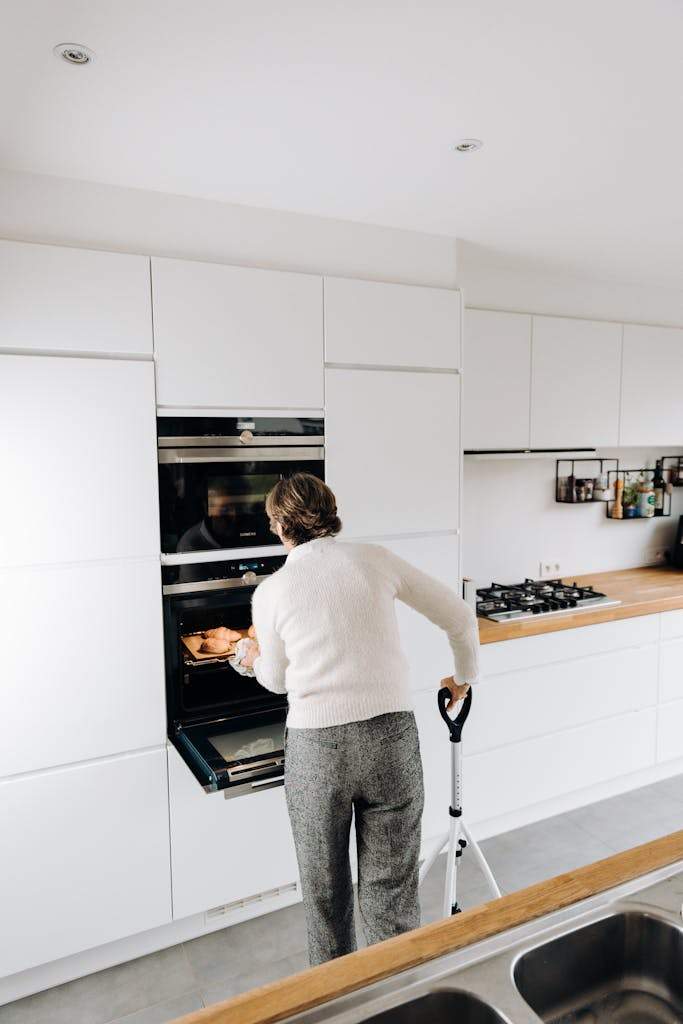
She had cooked in that kitchen for 40 years. Thanksgiving dinners for 18 people. Sunday breakfasts every week without fail. But after her second shoulder surgery, reaching the back of the base cabinet had become a daily battle with pain, and her daughter noticed during a visit that the corner of the kitchen island had left a bruise on her hip that she hadn’t even mentioned. The kitchen that had always been the heart of the house had quietly become one of its hazards.
Kitchen modifications for aging in place are among the most overlooked home safety investments, in part because the kitchen’s risks are subtler than the bathroom’s, and in part because the kitchen feels so familiar that its hazards go unnoticed until they don’t. This guide covers every meaningful kitchen modification for elderly safety and function: what to prioritize, what each change costs, what the design principles are, and how to approach a renovation that keeps you cooking confidently for decades to come. By the end, you’ll have a clear action plan, whether your budget is $200 or $20,000.
Why the Kitchen Deserves a Dedicated Aging-in-Place Plan
The bathroom gets most of the attention in aging-in-place planning and rightly so, given its acute fall risk. But the kitchen is where daily function is tested most continuously. It is where older adults spend significant time every day performing tasks that require reaching, bending, gripping, standing, and managing heat and sharp objects which are all physical demands that change meaningfully with age.
The National Institute on Aging (NIA) identifies the kitchen as a significant site of home injuries for older adults, with burns, cuts, and falls all occurring at meaningful rates in kitchen environments. Unlike bathroom falls which tend to be discrete identifiable events, kitchen hazards tend to accumulate gradually. A cabinet that requires stooping. A cooktop with controls that require reaching over a burner. A floor that becomes treacherous when wet near the sink. None of these feels urgent until one of them causes an injury.
Kitchen modifications for aging in place differ from bathroom modifications in one important way: they span a wider range of functional needs. Bathroom modifications are primarily about safety, fall prevention, and accessibility. Kitchen modifications address safety, but equally address daily functional independence, like the ability to prepare meals, manage the kitchen environment, and remain an active participant in one’s own nutrition and household life.
According to AARP research, meal preparation is among the activities of daily living most strongly linked to older adults’ sense of independence and quality of life. A kitchen that becomes difficult to navigate doesn’t just create safety risk; it erodes the daily pleasure and autonomy that home cooking represents for many seniors.
Understanding how to make a kitchen safe for seniors aging in place begins with recognizing that the kitchen needs to be assessed as a functional workspace, not just a safety environment. That assessment is what this guide provides.
For the complete aging-in-place guide covering bathroom modifications, care support, technology, and finances alongside kitchen design, see our comprehensive guide to aging in place here.
The Complete Guide to Kitchen Modifications for Aging in Place
Storage and Cabinet Accessibility
The most impactful category of kitchen modifications for elderly users is storage accessibility and this is because poor storage design forces the daily repetition of movements that are both fatiguing and risky.
Pull-Out Shelving and Drawers
Standard base cabinets with fixed shelves require kneeling, deep bending, or awkward reaching to access items stored beyond the front third of the cabinet. Over time, this daily physical demand becomes both painful and potentially unsafe, particularly for seniors with arthritis, lower back conditions, or balance limitations.
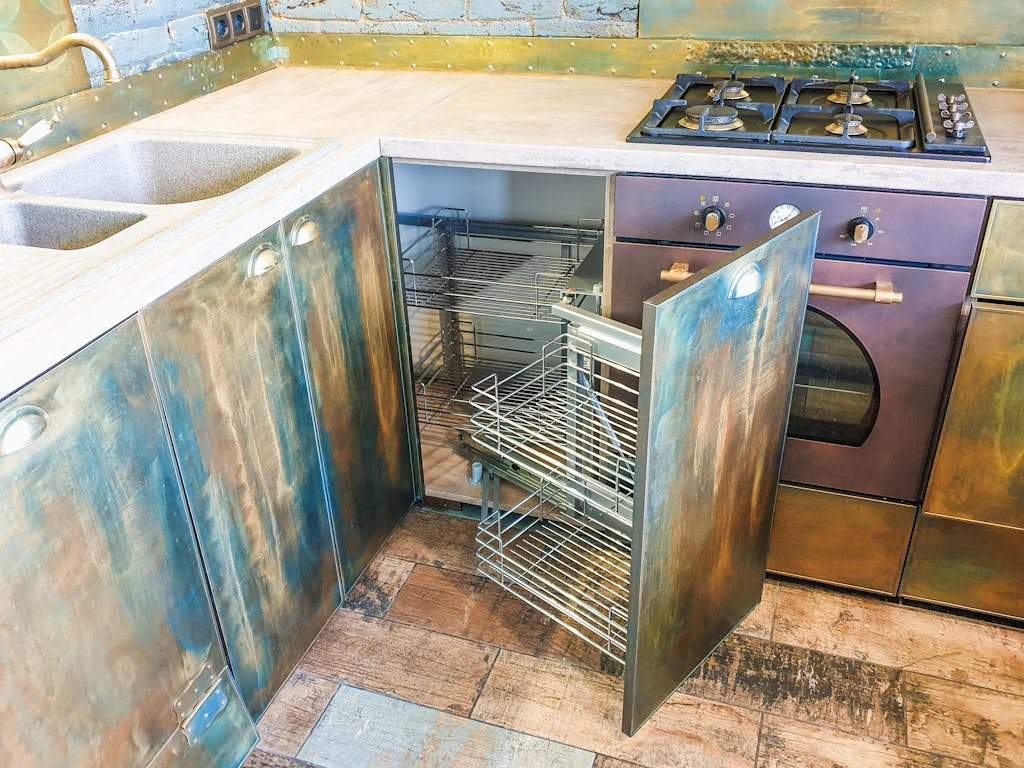
Pull-out shelving – drawer-style inserts that slide the full depth of the cabinet out to the user eliminates this entirely. Everything in the cabinet becomes accessible at counter height, with no bending required. This single modification is one of the highest-value, most cost-effective kitchen changes available.
Cost: $150–$400 per cabinet for pull-out shelf retrofits installed by a cabinet professional. Full-cabinet pull-out drawer systems run $300–$600 per unit. For a 10-cabinet kitchen, budget $2,000–$5,000 for a complete pull-out storage conversion.
Lazy Susan and Corner Cabinet Solutions
Corner base cabinets (that deep, difficult-to-access spaces at 90-degree turns) are among the most problematic storage locations in a standard kitchen. Items stored in the back corners are essentially inaccessible without significant reaching or bending.
Lazy Susan turntable systems make corner cabinet contents accessible with a simple rotation. Full-circle or D-shaped Lazy Susans bring everything within reach at a consistent height. For corner base cabinets, a pull-out Lazy Susan (which slides out before rotating) is more effective than a fixed rotating tray.
Cost: $100–$300 for Lazy Susan retrofit installation per corner cabinet.
Reorganizing Storage Height
This is the zero-cost modification that most people overlook. Frequently used items should be stored between knee height and shoulder height, as that’s the range that requires neither overhead reaching nor floor-level bending. Audit your kitchen storage and move what you use daily to accessible shelves. Reserve overhead storage for rarely used items, or eliminate it.
What to change in a kitchen for aging in place often starts here, not with renovation, but with reorganization.
Countertop and Work Surface Design
Standard kitchen countertops are installed at 36 inches, a height that works well for standing preparation but becomes problematic when sitting, when fatigue sets in during longer cooking sessions, or when reduced standing tolerance makes seated work necessary.
Varied Counter Heights
Aging in place kitchen design best practice includes at least one lowered work surface, typically 28–34 inches, that allows comfortable seated food preparation. This section might be a dedicated prep area, a kitchen island at a lower height, or a pull-out counter extension at the right height.
For users who alternate between standing and seated work, an adjustable-height countertop section installed with an electric lift mechanism provides both options in the same space. These are more expensive ($1,500–$4,000 for a single adjustable section) but represent the most flexible long-term solution.
Cost for fixed lowered counter section: $500–$2,000 depending on size and materials.
Knee Clearance for Seated Work
A lowered counter section is most functional when paired with knee clearance beneath, which is the open space below the counter that allows a seated user (in a chair, wheelchair, or on a stool) to pull close to the work surface. Standard base cabinets beneath a counter prevent this. Creating knee clearance requires removing the base cabinet under the lowered section and finishing the underside of the counter.
Cost: $300–$800 for knee clearance modification to an existing counter section.
Counter Edge and Corner Treatment
Sharp countertop edges and corners are a consistent source of minor injuries like bruises, cuts, and abrasions from contact with counter edges during navigation through a tight kitchen. Rounded or beveled counter edges and radius-cut corners on islands reduce this risk meaningfully.
When replacing countertops, specify rounded edge profiles (bullnose or eased edge) rather than sharp square edges. For existing countertops, edge guards like applied foam or rubber profiles provide protection at minimal cost ($20–$60 for a full kitchen).
Appliance Selection and Placement
Appliance choices and placement have more impact on kitchen safety and usability than most people realize, and appliance decisions are often made without any consideration of aging-in-place requirements.
Cooktop and Range Controls
Cooktop controls at the front or side of the unit, rather than at the back or requiring a reach over active burners are among the most important safety features for any kitchen used by an older adult. Reaching over a hot burner to adjust a back-mounted control is a consistent burn risk, particularly for anyone with reduced arm steadiness or limited reach.
When selecting a cooktop or range, front- or side-mounted controls are a non-negotiable safety feature for kitchen modifications for elderly safety. If a range with back-mounted controls is already installed, stove knob covers that disable accidental activation, combined with a stove-top guard (a rail across the front edge that prevents pots from sliding), address the most acute risks without replacement.
Induction cooktops offer an additional safety advantage: the cooktop surface itself does not get hot, only the cookware does. This eliminates the burn risk from accidentally touching the surface, and eliminates the risk of a dish towel or paper catching fire from contact with a hot burner. For aging in place kitchen design, induction is the recommended cooktop technology.
Cost for induction cooktop replacement: $400–$2,000 for the unit, plus $200–$500 for installation.
Refrigerator Configuration
Top-freezer refrigerators require overhead reaching to access freezer contents, which is the most frequently accessed part of the refrigerator for many households. Bottom-freezer models improve freezer access but require bending. French door or side-by-side models provide access to both the refrigerator and freezer at accessible heights without overhead reaching or deep bending.
For kitchen modifications for seniors aging in place, a French door refrigerator with the freezer in the bottom drawer is the most consistently recommended configuration. The main refrigerator compartment is accessible at full standing height, and the freezer drawer can be accessed without overhead reaching.
Cost: $800–$2,500 for a quality French door refrigerator; installation involves removing the existing unit and reconnecting water line if an ice maker is included.
Microwave Placement
Overhead microwaves, which are mounted above the range, require lifting hot, heavy dishes at arm height and tilting them to remove without spilling. This is among the most common kitchen injury scenarios for older adults and should be eliminated from any aging in place kitchen design.
Microwaves should be positioned at counter height, either as a countertop unit or built into a lower cabinet or island at approximately 24–30 inches from the floor. This allows the door to be opened and dishes removed without raising the arms above shoulder height.
Cost for microwave relocation: $100–$400, depending on whether cabinetry modification is required.
Dishwasher Height
Standard dishwashers require significant bending to load and unload the lower rack. Raising the dishwasher 6–10 inches on a platform brings the lower rack to a more accessible height, typically 24–30 inches from the floor, which eliminates the deep bending otherwise required.
Cost for dishwasher platform installation: $300–$800 including materials and labor.
Flooring and Fall Prevention
Kitchen flooring presents a specific combination of risks: hard surfaces that are unforgiving in a fall, areas that become wet near the sink and dishwasher, and transitions from the kitchen to adjacent rooms.
Non-Slip Flooring
High-gloss tile and polished hardwood become genuinely hazardous when wet. For kitchen flooring, matte or textured surfaces are significantly safer. Options include:
- Matte ceramic or porcelain tile: The most durable and cleanable option; specify a slip-resistance rating (DCOF – Dynamic Coefficient of Friction – of 0.42 or higher for residential kitchens)
- Luxury vinyl plank (LVP) with matte finish: Softer underfoot than tile, waterproof, and available in highly slip-resistant finishes
- Cork flooring: Naturally slip-resistant, cushioned (reduces injury severity in falls), and comfortable for extended standing, but requires regular sealing to maintain moisture resistance
Cost for kitchen flooring replacement: $1,500–$5,000 for a standard kitchen, depending on material and whether existing flooring requires removal.
Anti-Fatigue Mats
For seniors who spend extended time standing at the counter or stove, anti-fatigue mats reduce leg and lower back fatigue and provide some cushioning against falls. They must be secured at all edges to prevent edge lifting because an unsecured mat edge is a trip hazard. Look for beveled edges and non-slip backing.
Cost: $30–$100 per mat. Ensure any mat used in the kitchen is rated for kitchen use and has a beveled, non-trip edge profile.
Threshold Management
The transition between the kitchen floor and adjacent rooms, particularly common in homes where the kitchen has tile and the adjacent areas have hardwood or carpet, should be as flush as possible. Raised threshold strips are trip hazards for anyone using a walker or a cane. Low-profile transition strips (under ¼ inch) or flush transitions are the appropriate specification.
Faucet and Fixture Controls
Lever and Touchless Faucets
Standard kitchen faucets with round knob controls require grip and twisting, movements that become painful or difficult with arthritis or reduced grip strength. Single-lever faucets that are operated with a simple push in any direction require no grip or twist. Touchless or touch-activated faucets eliminate hand operation, activating with a light tap or proximity.
The American Occupational Therapy Association (AOTA) specifically identifies lever faucet controls as a high-priority kitchen modification for users with arthritis or reduced hand strength.
Cost for lever faucet replacement: $200–$600 installed. Touchless faucets: $300–$900 installed.
Pull-Down Spray Faucets
A pull-down spray head allows directed rinsing of dishes, produce, and the sink area without lifting heavy pots to the sink or repositioning the body. Combined with a lever control, a pull-down spray faucet addresses most of the functional demands of kitchen sink use accessibility.
Lighting
Poor kitchen lighting is a direct safety hazard, as it increases the risk of cutting injuries, burn contact, and missed visual cues about food safety. The NIA identifies adequate task lighting as a priority modification for kitchen safety in aging adults.
What adequate kitchen lighting requires:
- Under-cabinet task lighting over every counter work surface – this is the most impactful single lighting addition for kitchen safety
- Overhead lighting sufficient to illuminate the full kitchen without shadows across work surfaces
- Illuminated controls on appliances where possible – many modern ranges and microwaves have lit control panels that are significantly easier to read
- Contrasting colors on counter edges, drawer pulls, and appliance controls to support visual clarity for users with reduced contrast sensitivity
Cost for under-cabinet lighting installation: $200–$800 for a standard kitchen, depending on the system (plug-in vs. hardwired) and whether the cabinets are pre-wired.
Hardware and Handle Accessibility
Cabinet hardware is the one kitchen modification that almost every person with arthritis or reduced grip strength will notice immediately, and one of the most affordable changes available.
Round knobs require a precise pinch grip to operate. D-ring pulls, bar handles, and cup pulls allow operation with an open hand, a finger hook, or a fist, making it dramatically easier for arthritic or weakened hands.
Replacing cabinet hardware throughout a full kitchen typically costs $200–$800 in hardware plus $100–$300 for professional installation if desired. For a kitchen with 20–30 cabinet and drawer fronts, this is one of the most cost-effective accessibility improvements per dollar available anywhere in the home.
What to Do With This Information: Practical Next Steps
- Start with a kitchen safety walkthrough today. Walk through your kitchen and identify every task that causes pain, difficulty, or hesitation: reaching for items, bending to access storage, operating controls. Write each one down. This inventory drives your prioritization for any subsequent modifications. Our room-by-room assessment checklist can guide you. Check it out here
- Reorganize storage height before spending on renovation. Move frequently used items to accessible middle shelves. Clear overhead storage of daily-use items. This zero-cost step addresses one of the most common kitchen accessibility problems and takes an afternoon.
- Replace cabinet hardware with D-ring or bar pulls as your first paid modification. If arthritis or reduced grip strength affects your kitchen use, this $200–$800 change delivers an immediate, noticeable improvement to every single cabinet and drawer interaction. It is the highest-value-per-dollar kitchen modification available.
- Schedule a professional OT home assessment before planning any significant renovation. A licensed occupational therapist will evaluate your specific functional limitations against your kitchen’s layout and produce a prioritized modification list tailored to you. Ask your physician for a referral, or contact your local Area Agency on Aging.
- Use our complete remodeling checklist before hiring any contractor. Our aging in place remodeling checklist covers every kitchen modification category, and every other room so you go into contractor conversations with a complete, prioritized scope of work rather than an open-ended discussion.
- Hire a CAPS-certified contractor for any renovation work over $2,000. Kitchen modifications done without aging-in-place expertise can solve visible problems while missing functional ones.
When to See a Specialist
A licensed occupational therapist (OT) is the right first professional for kitchen modification planning, before any contractor is engaged. An OT assesses your specific physical capabilities against your kitchen’s actual layout and produces a modification recommendation based on how you work in that specific space.
For a significant structural kitchen renovation, like removing walls, relocating plumbing, and electrical work for induction cooktops or new appliances, a CAPS-certified contractor should execute the work. For projects involving gas line relocation, a licensed plumber is required regardless of other contractor credentials.
For broader guidance on navigating the healthcare professionals involved in aging-in-place planning, see the complete guide to aging in place here.
A Note for Family Members and Caregivers
If you’re helping a parent plan kitchen modifications, the most important thing you can do before any contractor conversations is observe how your parent actually works in the kitchen, not just whether it looks accessible. Watch which cabinets they avoid. Notice whether they routinely use a counter edge for balance while moving through the space. Pay attention to which tasks they’ve quietly stopped doing.
The kitchen modifications that matter most are the ones that address how a specific person actually uses their specific kitchen, and that knowledge comes from observation, not from a checklist.
If a parent is resistant to modification, frame changes as practical improvements rather than safety accommodations. Pull-out shelving is a kitchen upgrade. Better lighting is a comfort improvement. Lever handles are a design choice. The conversation is much easier when it isn’t framed as a response to decline.
For broader guidance on supporting a parent through home modification planning, including managing resistance and coordinating with contractors, see our resources on [building a care and support system].
The Bottom Line on Kitchen Modifications for Aging in Place
Kitchen modifications for aging in place range from a $15 reorganization to a $40,000 full renovation, and the modifications that matter most for most people fall closer to the lower end of that range.
Start with storage reorganization and hardware replacement. Add pull-out shelving, better lighting, and lever faucets in a first phase. Plan larger changes like countertop height variation, flooring replacement, and appliance upgrades as budget and timing allow, ideally coinciding with any scheduled kitchen renovation.
The most important principle in aging in place kitchen design is the same one that applies throughout the home: the best time to make these changes is before you need them urgently. A kitchen modified thoughtfully during a planned renovation costs a fraction of what it costs to retrofit under pressure after an injury.
Your next step: If you’re ready to evaluate your kitchen as part of a complete home safety plan, download our free Aging in Place Planning Checklist. It walks you through every kitchen modification alongside every other room in the house, giving you a complete picture of where your home stands and what to address first.
You’ve spent decades building a life in that kitchen; the right modifications will make sure it stays yours for decades more.