This post contains affiliate links. If you purchase through our links, we may earn a small commission at no extra cost to you. Our reviews are editorially independent – we recommend products we believe are genuinely useful for our readers, and we include honest assessments of limitations alongside strengths.
The bottom line upfront: The best grab bars for seniors are not the most expensive ones, the most decorative ones, or the ones marketed most aggressively. They are the ones with an honest 250-pound load rating, a 1.25–1.5 inch textured grip diameter, and most importantly, professional installation anchored to wall studs or solid blocking. Any bar that does not meet all three of those criteria is not a safety device. It is a false sense of security.
This guide evaluates every major grab bar category available to US buyers in 2026: straight bars, L-shaped bars, fold-down bars, tension bars, and toilet safety frames with honest assessments of what each does well, what each does poorly, and which specific situations each serves. By the end, you’ll know exactly which type of bar belongs in each location of your bathroom, what to look for on the specification label before buying, and what correct installation actually requires.
Quick Reference: Top Grab Bar Picks by Category
| Category | Best For | Price Range | Rating |
|---|---|---|---|
| Straight stainless steel bar | Primary shower and toilet wall bar | $25–$80 | ⭐⭐⭐⭐⭐ |
| L-shaped / angled bar | Toilet transfer support | $45–$120 | ⭐⭐⭐⭐⭐ |
| Fold-down flip bar | Small bathrooms, toilet side | $80–$200 | ⭐⭐⭐⭐ |
| Floor-to-ceiling tension bar | Renters, no-drill situations | $60–$150 | ⭐⭐⭐ |
| Tub clamp rail | Temporary / post-surgery use | $30–$80 | ⭐⭐⭐ |
| Suction cup bar | Travel only — not primary safety use | $20–$60 | ⭐⭐ |
Pricing reflects the current US retail market. Check current availability and pricing at the links in each section below.
What Are Grab Bars and Why This Category Matters
Grab bars – also called safety bars or assistive bars – are wall-mounted, floor-anchored, or tension-based supports designed to provide a stable gripping surface during bathroom transfers: stepping into and out of the shower, lowering onto and rising from the toilet, and recovering balance on a wet floor.
The Centers for Disease Control and Prevention (CDC) has identified grab bar installation as one of the highest-priority home fall prevention interventions for older adults. The evidence behind that recommendation is not subtle: bathroom falls account for a disproportionate share of the 36 million annual falls among US adults 65 and older, and a significant proportion of those falls happen at the exact moments a grab bar is designed to prevent stepping over a tub ledge, rising from the toilet, or losing footing on wet tile.
What most buyers don’t realize going in is that the category spans an enormous quality range. A $15 chrome bar from a discount retailer and an $85 stainless steel bar from a safety-specialized manufacturer both look like grab bars in a product photo. The difference in load rating, in grip surface, and in installation anchoring capacity can be the difference between a bar that holds and one that doesn’t.
For the complete context of bathroom safety modifications and how grab bars fit within a broader aging-in-place plan, see our complete guide to aging in place. This post evaluates grab bars specifically – every major type, their real strengths and limitations, and how to choose correctly for each location.
Who Needs Grab Bars and Who Should Read This Guide Closely
This guide is directly relevant to you if:
- You are 60 or older, and your bathroom currently has no grab bars. This is the single highest-priority safety modification available
- You have had a fall in the bathroom, even a minor one
- You use a cane, walker, or have balance or stability issues
- You are recovering from joint replacement, stroke, or any procedure affecting lower-limb strength or balance
- You are helping a parent or loved one address bathroom safety and want to make sure the right product gets installed correctly
You should approach this guide with adjusted expectations if:
- You are looking for a temporary solution while a loved one recovers from surgery. The tub clamp rail and floor-to-ceiling tension bar sections are most relevant to your situation
- You are renting and cannot drill into walls, the no-drill sections cover your options honestly, including their limitations
- You already have grab bars installed; the installation quality section will help you assess whether what’s there is actually safe
Detailed Assessment: Every Major Grab Bar Type
Straight Wall-Mounted Grab Bars – The Gold Standard
Overall assessment: The best grab bars for elderly safety are straight, wall-anchored stainless steel or quality chrome bars in the 24–36 inch range. This is where to start, and for most bathroom locations, where to finish.
Performance and load rating. A quality straight grab bar from a reputable manufacturer, such as Moen, Delta, Wingits, or AmazonBasics Safety carries an honest 500-pound load rating in all directions when correctly installed into wall studs. That is not a marketing number: it is the result of independent testing that goes well beyond the 250-pound ADA minimum. In practice, correct installation into a 2×4 stud with #10 or #12 structural screws will hold under any normal use load.
Grip quality. The best straight bars use a knurled grip surface – a machined diamond or crosshatch pattern that maintains traction on wet hands. This is the feature most often absent on lower-cost bars, which use a smooth, polished surface that becomes genuinely slippery when wet. For a bar that will be used by someone stepping out of a wet shower, grip surface texture is not optional.
Bar diameter and senior-specific usability. The ADA-specified range of 1.25–1.5 inches is where all quality bars should fall. Below that range, bars become difficult to grip with full hand closurea particularly for arthritis-affected hands. Above that range, grip requires wider hand span than many older adults can reliably achieve. Moen’s 1.25-inch LR2352CH and Delta’s 1.5-inch 40518-SS both hit the sweet spot. The Wingits Heavy Duty at 1.5 inches is particularly noted by occupational therapists for its grip-friendly diameter.
Physical design for limited dexterity. Straight bars offer no installation challenge from a handling perspective; they are symmetrical and position independently of user handedness. L-shaped bars (covered next) offer better toilet transfer support but require careful placement based on the user’s dominant hand. For users who prefer simplicity, a 32–36 inch straight bar installed at a 30-degree diagonal at the shower entry provides both lateral stability (lower grip position) and standing-assist support (upper position), effectively two functions from one bar.
Where straight bars fall short. They are a single-function device. A horizontal straight bar at the toilet provides lateral support while seated, but limited push-up assistance when rising. For toilet transfers specifically, an L-shaped bar or a fold-down bar typically serves the user better. Straight bars excel in the shower interior and at the shower entry point, their primary, highest-value applications.
What to look for on the label: ADA compliance claim, stated weight rating of 250 lbs minimum (quality bars state 500 lbs), stainless steel or solid brass construction, and knurled or textured grip surface.
Price range: $25–$80 per bar. Professional installation: $75–$150 per bar including hardware.
Caregiver note: Straight bar installation is manageable for a capable DIY adult if the wall studs are located and properly used. For tiled walls, professional installation is strongly recommended. Drilling into tile without the right bit and technique causes cracking that is expensive to repair.
[Check current pricing on Amazon for top-rated straight grab bars →]
L-Shaped and Angled Grab Bars – Best for Toilet Transfers
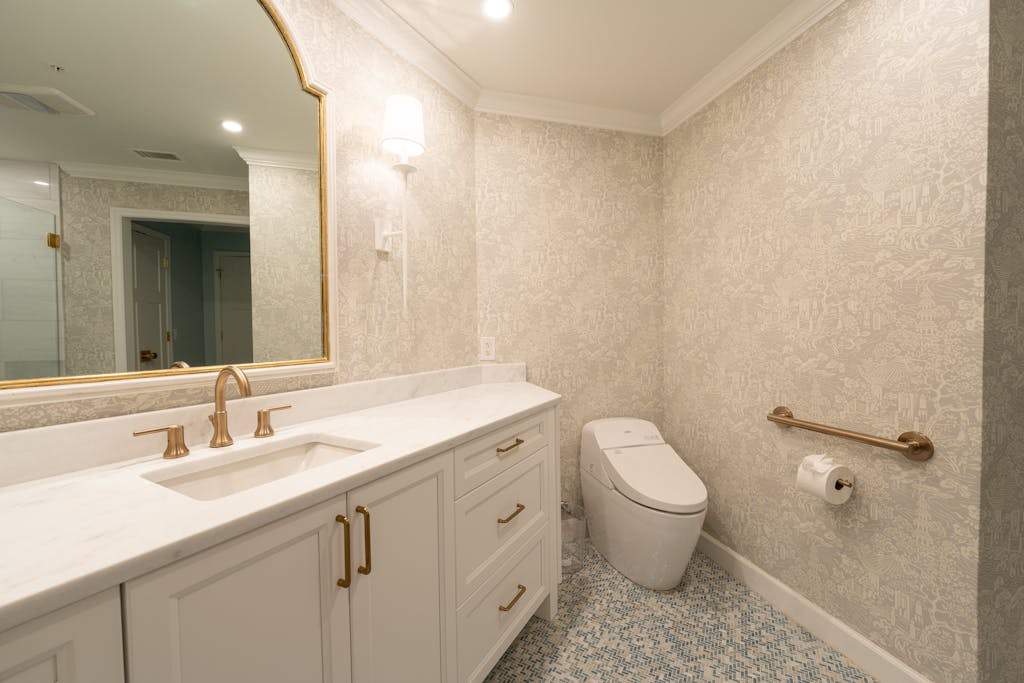
Overall assessment: L-shaped grab bars are among the best grab bars for elderly toilet transfers, specifically. They outperform straight bars for this application by providing both lateral seated support and vertical rising assistance in a single unit.
Performance. An L-shaped bar combines a horizontal section (typically 16–18 inches) with a vertical section (typically 30–32 inches) in a single anchored unit. The horizontal section provides lateral support while seated; the vertical section provides the pull-up grip for the rising motion. For most adults, the natural motion of rising from a toilet, leaning forward, gripping, and pushing upward, aligns precisely with the geometry of an L-bar when it is correctly positioned.
Positioning is critical. The horizontal section should be positioned at 33–36 inches from the floor; the bar should be placed on the dominant-hand side of the toilet, 7–8 inches from the toilet centerline. A bar placed on the wrong side or installed backwards, which happens regularly in DIY installations, provides awkward support that the user will not use consistently.
Senior-specific fit. For users with significant arthritis, an L-bar with a textured gripping surface across both arms is meaningfully easier to use than a smooth-surface bar. HealthCraft’s SuperPole products and the Drive Medical range are both well-regarded among occupational therapists for their grip surface quality. The Moen Home Care L-shaped bar (model 8924) is among the most widely installed by CAPS professionals in residential settings.
Where L-shaped bars fall short. They are more expensive than straight bars, they have a dominant-hand configuration that must be matched to the user before purchase, and they require precise placement to be effective. A poorly placed L-bar is not better than a well-placed straight bar; it may be worse, because the user’s natural movement won’t align with the support it offers. For users with bilateral weakness who need support on both sides of the toilet, a fold-down bar on one side and a wall-mounted bar on the other is often the better solution.
Price range: $45–$120 per unit. Installation: $100–$200 including professional positioning consultation.
[Check current pricing on Amazon for L-shaped grab bars →]
Fold-Down / Flip-Up Grab Bars – Best for Small Bathrooms
Overall assessment: Fold-down grab bars are genuinely excellent products for the right application, toilet support in small bathrooms where a fixed bar would obstruct access. Their main limitation is cost and the requirement for solid wall anchoring.
Performance. A quality fold-down bar deployed for use, folded flat against the wall when not needed, provides toilet transfer support equivalent to a fixed bar when deployed. The hinge mechanism in well-built units (Ponte Giulio, Moen, ADA-compliant commercial models) locks securely in the deployed position with a rated load capacity of 250–300 lbs. The fold-down action does not compromise structural integrity when the bar is properly loaded.
Ease of use for seniors. The deployment action – swinging the bar down from the wall – requires one hand and moderate grip strength. For users with severe bilateral arthritis or very limited hand strength, the deployment action may be effortful. Most users manage it easily. The HealthCraft Folding Grab Bar uses a lever-style release rather than a lift-and-lower motion, which several OTs note is easier for arthritic hands.
Installation requirements. Fold-down bars carry heavier installation requirements than fixed bars because the hinge mechanism concentrates lateral stress differently than a static bar. They must be anchored to studs or solid blocking, not drywall anchors. This is a job for a CAPS-certified contractor or an experienced handyman familiar with the specific anchoring requirements.
Where fold-down bars fall short. Cost is higher than fixed bars for an equivalent safety function. The fold-down mechanism adds a mechanical component that can wear over time; inspect the hinge annually. And they are not the right choice for users who might forget to deploy the bar before use cognitive considerations matter here.
Price range: $80–$200 per unit. Installation: $150–$250 including contractor placement.
[Check current pricing on Amazon for fold-down grab bars →]
Floor-to-Ceiling Tension Bars – The Honest Assessment
Overall assessment: Floor-to-ceiling tension bars are a legitimate option for renters and for situations where wall drilling is genuinely not possible. They are not a substitute for wall-anchored bars where anchoring is an option. Be clear-eyed about their limitations.
Performance. Quality tension bars – the Stander Security Pole and Curve is the most widely recommended in this category – use a spring-tension mechanism to press against floor and ceiling surfaces. When correctly installed on a flat floor with a solid ceiling and checked regularly for tension, they provide a stable gripping surface for standing-assist and lateral support.
Where tension bars fall short. The tension mechanism can loosen over time, particularly with regular use. A bar that was properly tensioned at installation may have reduced holding force six months later if not checked. Ceiling materials vary, including popcorn ceilings, drop ceilings, and some plaster ceilings that do not hold tension adequately. Uneven floors, soft flooring materials, and carpet all reduce reliability. Unlike a stud-anchored bar, a tension bar’s security depends on ongoing user maintenance.
For renters, this is often the best available option. A correctly installed and regularly checked Stander Security Pole provides meaningful support for standing transfers from seated positions. For shower use where the floor is wet, and the load dynamics are different from a standing transfer, it is not the recommended primary safety device. A properly anchored bar is always safer.
Price range: $60–$150. No professional installation required, but follow the manufacturer’s tensioning instructions precisely.
[Check current pricing for floor-to-ceiling tension bars →]
Suction Cup Grab Bars — Be Honest About Their Limits
Overall assessment: Suction cup grab bars are appropriate for travel use only. They are not appropriate as primary bathroom safety devices for regular home use. Full stop.
The grip strength of a suction cup on tile depends on the tile surface, the cleanliness of both surfaces, the ambient temperature, and humidity, all of which change constantly in a bathroom environment. Consumer safety organizations and occupational therapists consistently advise against relying on suction cup bars as primary fall prevention devices.
Their legitimate use case: A senior who travels and needs to use hotel bathrooms or unfamiliar bathrooms has no option for wall anchoring. A quality suction cup bar the Vive Health model and Carex brand are well-reviewed, provides better support than no bar at all in a travel context. Use it for that purpose, inspect the suction seal before every use, and do not treat it as equivalent to a mounted bar.
Price range: $20–$60. Available through Amazon and most medical supply retailers.
Tub Clamp Rails – Honest Assessment
Overall assessment: Tub clamp rails are a useful short-term or transition solution for step-over tub entry and exit. They are not a permanent aging-in-place solution, and their stability degrades over time with regular use.
Tub clamp rails attach to the tub rim using a pressure clamp mechanism. Quality models like Drive Medical and Carex are the most widely available and provide meaningful support for stepping over the tub rim when the alternative is no support at all. They are particularly useful in the period between a fall or surgery and a planned bathroom renovation.
Where they fall short. The clamp mechanism can shift laterally on smooth tub rims. The height of the rail is fixed by the tub rim height, which may not be optimal for the user. They provide limited support for the seated-to-standing transfer inside the tub. For long-term use, a wall-anchored bar is the appropriate solution.
Price range: $30–$80. Available through Amazon and medical supply retailers without a prescription.
Pricing, Availability, and What to Expect at Each Price Point
Under $40: Straight bars from home improvement retailers and Amazon. At this price, scrutinize the load rating and grip surface. Avoid any bar that does not state ADA compliance or a specific weight rating. Many bars in this range use smooth chrome over zinc alloy acceptable if the load rating is verified, but lower durability than stainless steel over a 10-year horizon.
$40–$80: The sweet spot for straight and L-shaped bars from established brands like Moen, Delta, and Drive Medical. At this price, you get stainless steel or quality brass construction, textured grip surfaces, and honest load ratings. This is the right range for primary bathroom grab bar installations.
$80–$200: Fold-down bars, premium straight bars in specialty finishes, and Wingits specialty mounting hardware. At this price you’re paying for either enhanced functionality (fold-down mechanism), specialty aesthetics (designer finishes), or mounting system reliability for non-standard wall situations.
Over $200: Commercial-grade hardware adapted for residential use, custom-length bars, and specialty systems. Generally not necessary for standard residential applications.
Where to buy: Amazon carries the widest selection with reliable return policies. Lowe’s and Home Depot stock Moen and Delta lines in-store. Medical supply stores carry Drive Medical and Carex lines. Buying direct from manufacturers (Moen, Delta) provides warranty support but rarely price advantage.
Installation cost: Budget $75–$150 per bar for professional installation, or $250–$500 for a complete three-bar bathroom setup. CAPS-certified contractors charge at the higher end of this range — the expertise premium is worth it for correct placement.
Grab bar pricing is generally stable, but check current listings before purchase.
How Grab Bars Compare to Each Other and to Alternatives
Grab Bars vs. Toilet Safety Frames
Toilet safety frames, like freestanding frames that bracket the toilet with bilateral armrests, are a legitimate alternative to wall-mounted grab bars for toilet transfers. They are easier to install (no drilling required), provide bilateral support, and can be purchased and deployed immediately. Their limitation: they can tip laterally if loaded off-center, they occupy significant floor space, and they are generally less durable than wall-mounted bars. For renters or for immediate post-surgery use, they are a good option. For long-term home use, a wall-mounted bar provides better stability.
Wall-Mounted Bars vs. Suction Cup Bars
There is no meaningful comparison here for primary home use. Suction cup bars are travel accessories. Wall-mounted bars are safety devices. If the choice is between a suction cup bar and no bar, the suction cup bar provides some benefit. If the choice is between a suction cup bar and a wall-mounted bar, there is no choice.
Grab Bars vs. Full Bathroom Renovation
Grab bars are often the first and most impactful step, not a substitute for a curbless shower conversion or a comfort-height toilet, but a meaningful safety intervention that can be completed in an afternoon for $300–$500 while larger renovation planning proceeds. The two approaches are complementary, not competing. Start with bars. Plan renovation around them.
For a complete comparison of bathroom modification options and how they work together, see our guide to bathroom modifications for aging in place.
Real-World Use Considerations for Seniors
Set up and installation. Grab bar installation is not a senior-DIY project for most people. It requires a stud finder, a drill, specific drill bits for tiled walls, and knowledge of which screws and anchoring methods are appropriate for different wall constructions. More importantly, the consequences of a poorly installed bar are not a loose towel holder; they are a bar that fails under body weight. Unless the senior or their family member is genuinely comfortable with this level of home improvement work, professional installation is the right call.
For users with arthritis. Bar diameter matters more for this group than any other. The 1.25-inch diameter is significantly easier to grip for arthritic hands than the 1.5-inch diameter for most users. Textured grip surfaces matter doubly; reduced grip strength combined with a smooth wet bar surface is a significant use hazard. Drive Medical and Moen Home Care bars in 1.25-inch diameter with knurled surfaces are the most frequently recommended by OTs for arthritis-affected users.
For users with reduced vision. High-contrast finish matters. A matte black or oil-rubbed bronze bar on a white or light tile wall is dramatically more visible than a chrome bar on light tile. This is not only an aesthetic consideration, the National Institute on Aging (NIA) specifically notes that visual contrast in the bathroom environment meaningfully affects fall risk for people with reduced visual acuity.
Customer support experience. Moen and Delta both offer US-based customer support and strong warranty programs (Moen’s Limited Lifetime Warranty is among the most comprehensive in the category). Drive Medical has variable customer service reviews, adequate for standard warranty claims, but less responsive for complex situations. For all major brands, installation questions are better directed to a CAPS contractor than to the manufacturer’s customer service.
Caregiver involvement. For the installation process, caregiver or family member involvement is appropriate and often necessary. For ongoing use, grab bars should require no ongoing management; they either work or they need to be inspected and re-anchored. Annual inspection of all bars, testing each one with firm lateral and downward pressure, is a reasonable maintenance practice that a caregiver can incorporate into a regular home safety check.
The Verdict: Final Assessment and Recommendation
What the Best Grab Bars for Seniors Must Deliver
Essential strengths:
- 250-pound minimum load rating in all directions, stated explicitly on the product (quality bars state 500 lbs)
- 1.25–1.5 inch textured grip diameter – knurled or crosshatch surface, not smooth polished chrome
- Stainless steel or quality brass construction for durability in a wet, high-humidity environment
- Installation into wall studs or solid blocking – this is not optional and cannot be achieved with drywall anchors alone
Genuine limitations to acknowledge:
- No bar is appropriately installed to drywall alone – the installation substrate matters as much as the bar itself
- Suction cup and clamp-on bars are not primary safety devices for regular home use – be honest with yourself about what they can and cannot reliably hold
- Aesthetic options are limited at lower price points – high-quality safety function and attractive design are not mutually exclusive, but they cost more than $30
Buy confidently if: You are purchasing a 1.25–1.5 inch diameter bar with a stated 250+ lb load rating, a textured grip surface, and a plan for professional installation into wall studs. Moen Home Care, Delta’s ADA-compliant line, Wingits Heavy Duty, and Drive Medical’s steel bars are all reliably good choices at their respective price points.
Reconsider and research further if: You are planning to install a bar to drywall alone, purchase a bar without a stated load rating, or use a suction cup bar as your primary bathroom safety device. For renters, a Stander Security Pole or a quality toilet safety frame are better primary options than suction cup bars.
If you’re ready to purchase, check current pricing and availability for the top-rated grab bars in this category: → [View top-rated grab bars on Amazon] → [Find grab bars at Lowe’s or Home Depot for in-store pickup]
A Note for Caregivers Buying Grab Bars on Behalf of a Senior
Before purchasing, confirm two things: which locations need bars (toilet, shower entry, shower interior, and tub if applicable), and whether the bathroom walls have accessible studs in those locations. A stud finder will tell you. Purchasing before confirming the wall structure leads to bars that cannot be installed where they’re needed.
Involve your parent in the selection of finish and style where possible. Resistance to grab bar installation is common and understandable – many older adults associate them with institutionalization. Letting your parent choose between finish options (brushed nickel vs. matte black vs. oil-rubbed bronze) gives them agency in the decision and meaningfully increases the likelihood they’ll actually use the bars consistently.
If you’re coordinating a broader bathroom safety assessment, see our aging in place home assessment guide for a complete room-by-room framework that covers grab bars alongside every other modification the bathroom may need.
For broader guidance on navigating home modification decisions with an aging parent — including how to handle resistance, how to coordinate with contractors, and how to prioritize when budget is limited- our resources on [building a care and support system] address the caregiving dimension of these decisions in depth.