The new kitchen looked beautiful on paper, with fresh cabinets, updated appliances, and clean lines throughout. But three months after the renovation was finished, her daughter noticed that her mother was doing all her food preparation at the kitchen table instead. The countertops were 36 inches high. Her mother, who used a rollator walker and spent much of her cooking time seated, found them completely unusable for anything requiring sustained effort. Nobody had asked about her height, her walker, or how she actually worked in the kitchen before the renovation began.
Height-adjustable countertops are the kitchen modification most often absent from aging-in-place renovations, and the one that makes the most difference for seniors who can no longer stand comfortably for extended periods. This guide covers every type of height-adjustable countertop available for residential kitchens: fixed lowered surfaces, motorized electric-lift systems, manual crank systems, and adjustable kitchen cabinets for elderly users who need storage at accessible heights. By the end, you’ll know which system fits your situation, what each type costs, and what questions to bring to your contractor.
Why Standard Counter Height Doesn’t Work for Every Senior
Standard kitchen countertops in the United States are installed at 36 inches from the floor. That height was established as the ergonomic standard for standing food preparation by an average-height adult – approximately 5’4″ to 5’8″ – performing tasks while fully weight-bearing.
For seniors who have retired from full-time standing preparation, that single fixed height creates a cascade of functional problems. A senior who is 5’1″ works at a countertop that is too high for comfortable extended use. A senior using a rollator walker who rests frequently or leans on the counter for stability works at a surface not designed for partial weight support. A senior who has shifted to primarily seated kitchen work, maybe due to joint replacement recovery, chronic fatigue, heart failure, or advancing arthritis, cannot pull close to a 36-inch counter in a standard chair, a wheelchair, or a kitchen stool without significant trunk flexion or arm extension.
The American Occupational Therapy Association (AOTA) identifies varied counter height as a core element of accessible kitchen design, specifically noting that a single-height kitchen forces all users into the same posture regardless of their individual physical capabilities. The recommendation is a kitchen with at least one work surface at a lower height: typically 28–34 inches for seated use, combined with the standard 36-inch height for tasks where standing is preferred or possible.
Height-adjustable countertops are surfaces that can be moved between heights either manually or mechanically, and they take this principle to its logical conclusion. Rather than choosing between a fixed standing height or a fixed seated height, an adjustable system serves the same user across different tasks and across changing physical needs over time.
According to the U.S. Census Bureau, approximately 40% of adults 65 and older report some limitation in physical functioning that affects daily activities, and it’s a proportion that increases significantly with age. For the complete guide on kitchen modifications alongside bathroom, bedroom, and whole-home planning, see our comprehensive guide to aging in place here.
The Complete Guide to Height-adjustable Countertops and Cabinets
Understanding Your Options: Four Distinct Systems
Before evaluating specific products, it helps to understand that height-adjustable countertops for residential kitchens fall into four distinct categories, with each serving a different need, at a different price point, with different installation requirements.
Fixed lowered counter sections are not adjustable in the mechanical sense, but they are the most affordable and most widely installed solution for seniors who primarily work at seated height. A single counter section is installed at 28–34 inches rather than the standard 36 inches; it’s permanently lower, serving seated work consistently. This is the right solution when the user has a clear, stable preferred working height.
Manual crank-adjustable systems use a mechanical crank mechanism to raise and lower the counter surface within a range, typically 28–36 inches. No electricity required. The user cranks the surface to their preferred height before beginning work. These are less expensive than motorized systems and more reliable long-term, but require the physical ability to operate the crank, which can be challenging for users with significant hand weakness or arthritis.
Electric motorized lift systems use an electric motor, which is typically activated by a wall switch, pendant button, or touch control, to raise and lower the counter surface at the press of a button. These are the most accessible options for seniors who cannot operate a manual crank, height-adjustable countertops for wheelchair users who need hands-free height adjustment, and anyone who adjusts height frequently. They are also the most expensive.
Pull-out or fold-down counter extensions create an additional lower work surface without modifying existing countertops. This is a pull-out section beneath the counter, or a fold-down panel attached to the wall or island, that deploys at seated height when needed and retracts when not in use. These are lower in cost than full adjustable systems and work well as supplementary work surfaces rather than primary preparation areas.
Fixed Lowered Counter Sections: The Practical Starting Point
For most seniors, including those who work primarily seated but don’t need to adjust height frequently, a fixed lower counter section is the most practical, most cost-effective first modification.
Design and Dimensions
The target height for a seated work surface is determined by the user’s elbow height when seated, typically 28–34 inches for most adults. A licensed OT can measure this precisely for your specific seated posture and chair or wheelchair height. The standard accessible design recommendation from the U.S. Access Board for a seated work surface is 34 inches maximum height with knee clearance beneath.
For wheelchair users specifically, knee clearance is not optional, as it is the feature that makes seated use possible. Knee clearance requires open space beneath the counter (no base cabinet) measuring at least 27 inches high, 30 inches wide, and 19 inches deep. This means removing the base cabinet under the lowered section entirely, finishing the underside of the counter, and insulating any exposed pipes to prevent contact burns.
Cost
- Basic fixed lower section (countertop only, laminate, knee clearance modification): $500–$1,500
- Mid-range fixed lower section (solid surface or quartz countertop, finished knee clearance, coordinated cabinetry): $1,500–$4,000
- Full lower counter zone (multiple lower sections across a kitchen, integrated with accessible storage below): $4,000–$10,000
Who This Is Best For
Fixed lower counter sections work best for seniors with a stable preferred working height, someone who knows they will always work seated, or someone who knows they will always prefer a specific lower standing height. If needs are likely to change, or if the kitchen is shared with users who prefer the standard 36-inch height, a mechanical or motorized adjustable system provides more flexibility.
Manual Crank-Adjustable Countertop Systems
Manual crank-adjustable countertops, also called height-adjustable work surfaces or sit-stand countertop systems, use a mechanical scissor-lift or column-lift mechanism with a hand crank to adjust the surface height within a range. Most residential systems adjust from approximately 28 to 36 inches, covering both seated and standard standing heights.
How They Work
The countertop section is mounted on a mechanism that telescopes up or down when the crank is turned. The crank is typically located at the front face of the cabinet below the counter, accessible without bending. A locking mechanism holds the surface at the selected height. Quality systems are smooth to operate and hold their position reliably under working loads.
Key Considerations for Seniors
The crank mechanism requires moderate hand strength and grip, the same rotational motion as operating a doorknob, sustained for several rotations per inch of height change. For seniors with mild to moderate arthritis, most manual systems are operable but require effort. For seniors with significant hand weakness, severe arthritis, or limited bilateral hand function, a manual crank is likely not the right solution; an electric system is more appropriate.
Height adjustment time with a manual crank is typically 15–45 seconds for a full range adjustment. For users who adjust frequently, this can become inconvenient. For users who set and leave at a consistent height, it is rarely an issue.
Leading System Types
Manual crank systems are available from cabinet manufacturers who specialize in accessible kitchen design, companies such as IKEA’s accessible kitchen line (which offers height-adjustable cabinet frames), Häfele’s functional hardware division, and specialty accessible kitchen designers. Custom-built manual systems from CAPS-certified cabinet contractors are also common and allow precise height range customization.
Cost: Manual crank-adjustable countertop sections: $1,500–$4,500 per section, including mechanism, countertop material, and installation.
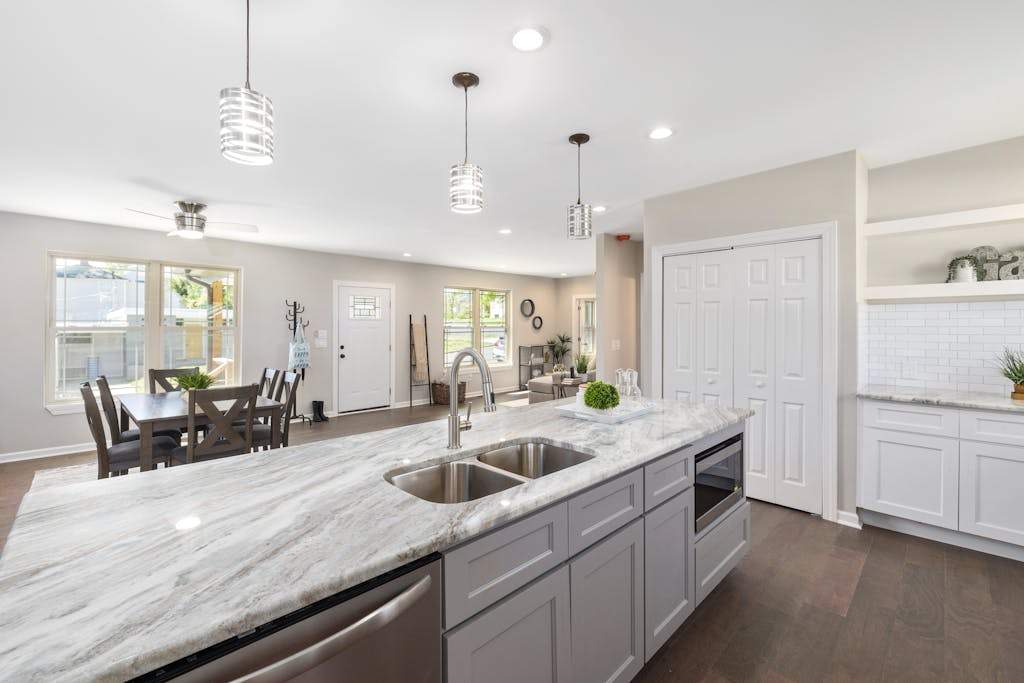
Electric Motorized Adjustable Countertop Systems
Electric motorized adjustable countertops, sometimes called height-adjustable countertops for wheelchair users or powered sit-stand kitchen surfaces, are the most accessible and most flexible option available. A motor (typically DC electric, quiet operation) raises and lowers the surface at the press of a button, with no physical effort from the user.
How They Work
The countertop section is mounted on electric column lifts, which are typically two columns for a standard section, that extend and retract using electric motors. A wall-mounted control panel, a pendant switch, or a touchscreen interface activates the adjustment. Most systems include preset height memory buttons that allow the user to program their preferred seated and standing heights and recall them with a single press.
Adjustment speed is typically 1–2 inches per second; a full 8-inch range adjustment takes 4–8 seconds. The motion is smooth and continuous, stopping immediately when the button is released.
Safety Features to Specify
Quality motorized systems include anti-collision detection, the motor stops and reverses if downward movement encounters resistance (a hand, a cup, a child). This is an important safety specification, not a luxury add-on. Require it from any contractor proposing a motorized system.
Weight capacity varies by system. Standard residential systems carry 200–300 lbs of working load. For heavy stone countertops (granite, quartz) or large work surfaces, confirm the specified capacity covers the combined weight of the countertop and typical working loads.
The Best Adjustable Height Countertops for Seniors: What to Look For
When evaluating motorized systems for senior use, prioritize these specifications:
- Simple one-touch or two-touch controls – avoid systems requiring multiple steps or screen navigation to initiate adjustment
- Audible or visual feedback when adjustment is complete
- Memory preset positions for at least two heights (seated and standing)
- Quiet motor operation – less than 50 dB during adjustment, comparable to normal conversation
- Anti-collision safety stop
- Manual override in case of power failure – the ability to lower the surface manually if the motor is unavailable
Cost
Electric motorized adjustable countertop sections represent a significant investment:
- Entry-level motorized section (single-motor column lift, laminate top, basic controls): $3,000–$5,500 installed
- Mid-range motorized section (dual-column lift, solid surface countertop, preset memory controls): $5,500–$9,000 installed
- Premium system (heavy-duty dual columns, stone countertop, integrated controls, anti-collision): $9,000–$15,000+ installed
For kitchens where the entire preparation area needs to be height-adjustable, which is common in kitchens designed for full-time wheelchair users, full-perimeter motorized systems can run $20,000–$40,000 for a complete kitchen. These are typically funded through VA accessibility grants (SAH/SHA programs) or Medicaid HCBS waiver programs for qualifying individuals.
Adjustable Kitchen Cabinets for Elderly Users
Adjustable kitchen cabinets for elderly users address the storage dimension of accessibility, not just the work surface, but the full range of kitchen storage that must be accessible without overhead reaching or deep bending.
Motorized Wall Cabinet Lowering Systems
Standard wall cabinets, which are mounted at 54 inches or higher, are beyond the comfortable reach of most seniors and completely inaccessible from a seated position. Motorized pull-down cabinet systems bring the cabinet contents to counter level at the press of a button.
These systems mount inside standard wall cabinets. The interior shelves extend downward on motorized arms when activated, bringing contents to approximately counter height. When not in use, the shelves retract to their storage position inside the cabinet.
Key considerations:
- Maximum load capacity per shelf is typically 20–30 lbs, which is adequate for dishware and dry goods, not for heavy cast iron or full appliances
- Cabinet depth must accommodate the mechanism (typically standard 12-inch depth or deeper)
- Installation requires cabinet modification and electrical connection
Cost: $400–$1,200 per unit for the mechanism, plus $200–$500 for installation. Most kitchens would install 2–4 units at the highest-priority wall cabinet locations.
Leading manufacturers of residential pull-down cabinet systems include Rev-A-Shelf and Hafele, both widely available through kitchen and bath supply distributors and CAPS-certified cabinet contractors.
Adjustable-Height Base Cabinet Systems
Several European cabinet manufacturers, most notably IKEA’s SEKTION line and Häfele’s functional hardware, offer base cabinet frames with height-adjustable legs that allow the cabinet height (and therefore the countertop height) to be set at installation. These are not infinitely adjustable in use, but they allow the installer to set the cabinet at a custom height rather than the standard 34.5-inch base cabinet height.
This approach is particularly useful in aging-in-place kitchen design, where the goal is a fixed lowered section at a specific custom height for a specific user’s seated dimensions, and is more precise than standard counter height modification.
Cost: Adjustable-leg base cabinet frames: $100–$400 per cabinet unit in materials. Installation cost is comparable to standard cabinet installation.
Pull-Out Storage Systems
Pull-out shelving, drawer inserts, and base cabinet organizers, which are covered in depth in our kitchen modifications for aging in place guide, are the most affordable and most widely applicable adjustable storage solutions for seniors. While technically not “height adjustable,” pull-out systems bring cabinet contents to a consistent, accessible height regardless of where they are stored, eliminating the bending and reaching that fixed shelves require.
For seniors who need better kitchen accessibility but are not yet ready for a full counter height renovation, pull-out shelving is the highest-value first step in the storage accessibility journey.
A Note for Family Members and Caregivers
If you’re helping a parent plan an accessible kitchen, the most common mistake is specifying a standard “accessible height” of 34 inches without measuring the actual person. Counter height for seated work is as individual as shoe size, which depends on the person’s specific seated height, their chair or wheelchair dimensions, and their preferred working posture.
Involve your parent in the decision about fixed vs. adjustable and in the selection of control style for any motorized system. A parent who doesn’t understand how to operate the controls on a motorized counter, or who was not consulted about the height range, may simply stop using it.
For broader guidance on coordinating kitchen and home modification decisions with a parent, including managing contractor relationships and prioritizing when the budget is limited, see our resources on [building a care and support system].
The Bottom Line on Adjustable Height Countertops
Height-adjustable countertops are among the most impactful kitchen modifications available for seniors who can no longer work comfortably at the standard 36-inch counter height, and are the most frequently absent from standard aging-in-place kitchen renovations.
The right system depends on three things: how often the height needs to change, whether the user can operate a manual crank, and what the budget supports. For stable single-height needs, a fixed lowered section delivers high value at lower cost. For shared kitchens and variable needs, a motorized system is the most accessible long-term investment.
No modification will serve the user well if it’s built to the wrong height. Get the OT measurement first. Specify from that measurement. Everything else follows.
Your next step: Before finalizing any kitchen modification plan, make sure you have a complete picture of every kitchen accessibility need, not just counter height. Our kitchen modifications for aging in place guide covers storage, appliances, flooring, lighting, and fixtures in great depth, giving you a complete kitchen accessibility plan rather than a single isolated modification.
Getting the kitchen right is one of the most meaningful investments in your daily independence, and with the right specification, it will serve you for decades to come.