She had managed the three front steps for 35 years without a second thought. Then the hip replacement changed the calculation. Not dramatically, not all at once, but just gradually, over six months, until her daughter noticed that she had stopped using the front door entirely. She was entering through the garage instead, which added 40 feet and two more threshold crossings to every trip in and out of the house. Nobody had addressed the front steps. It had just quietly become easier to avoid them.
Entryway modifications for aging in place are the home safety changes most often deferred, because the entry feels like a structural problem requiring major renovation, and because workarounds like the garage route seem to solve the immediate issue. But the entry is the gateway to independence. A senior who cannot safely enter and exit their own home on their own terms has already lost something significant, even if they haven’t named it yet.
This guide covers every home entryway modification for seniors that matters: from the simplest and least expensive threshold and lighting fixes to complete zero-step entry construction. By the end, you’ll know exactly what your entry needs, what it costs, and how to sequence the work, whether your budget is $50 or $15,000.
Why the Entryway Deserves Early Attention in Any Aging-in-Place Plan
The home entry is the first and last barrier between your home and the world. It is also, for most older adults, one of the least modified areas of the home, despite being a concentrated fall risk zone with multiple hazardous features operating simultaneously.
The Centers for Disease Control and Prevention (CDC) identifies outdoor steps and entry transitions as significant fall risk locations for older adults. The entry combines nearly every fall risk factor in one confined space: uneven or sloped walkways, steps with or without adequate railings, threshold lips that catch canes and walker wheels, often-poor lighting in both daytime and nighttime conditions, and weather exposure that creates wet or icy surfaces that simply do not exist inside the home.
Home entrance modifications for seniors also carry a dimension that other room modifications don’t: they affect the person’s ability to leave the home independently for medical appointments, errands, social activities, and community participation. The National Institute on Aging (NIA) has documented the connection between mobility limitation, social isolation, and accelerated functional decline in older adults. An entry that is difficult to navigate doesn’t just create safety risk; it progressively reduces the range of life that feels accessible.
What most people misunderstand about entryway modifications for aging in place is the range of solutions available. When people think of “entry modification,” they often think of a wheelchair ramp, which on its own is a major, expensive, permanent construction project. That is one solution, and the right one in some situations. But there are many others: prefabricated modular ramps that install in a day and can be reconfigured, zero-step entry creation through grading, portable threshold ramps that eliminate small lips without any construction, and targeted railing and lighting improvements that address the most acute risks at minimal cost.
The right solution depends on the specific entry, the specific person’s mobility needs, and the specific combination of hazards present. Understanding the full range is the starting point for making a good decision.
For the complete guide on aging-in-place home planning covering bathroom, bedroom, kitchen, and living room modifications alongside the entryway, see our comprehensive guide to aging in place.
Complete Guide to Entryway Modifications for Aging in Place
Step 1: Assess What You’re Actually Working With
Before any modification is planned or purchased, a structured assessment of the entry is essential. Home entryway modifications for seniors that work are always matched to the specific entry’s characteristics, not sourced from a generic checklist.
Walk the path from your primary parking area or the street to every door you use regularly. Do this at a normal pace, then slower. Then do it in the dark, or with reduced lighting, to simulate nighttime conditions. Note every point where you slow down, feel uncertain, or compensate in any way.
What to document:
- How many steps at each entry, and the rise height of each step
- Whether handrails are present, and whether they run the full stair length
- The condition and surface of walkways (cracked, sloped, uneven, narrow)
- Threshold heights at each door (measure with a tape measure)
- Lighting coverage at night
- Door handle type and door width
- Any slope or cross-slope on approach walkways
This assessment gives you a complete picture of every hazard, and prevents the common mistake of addressing one obvious problem (the steps) while leaving other hazards (the threshold lip, the unlit walkway) unaddressed.
Addressing Steps: From Handrails to Complete Ramp Solutions
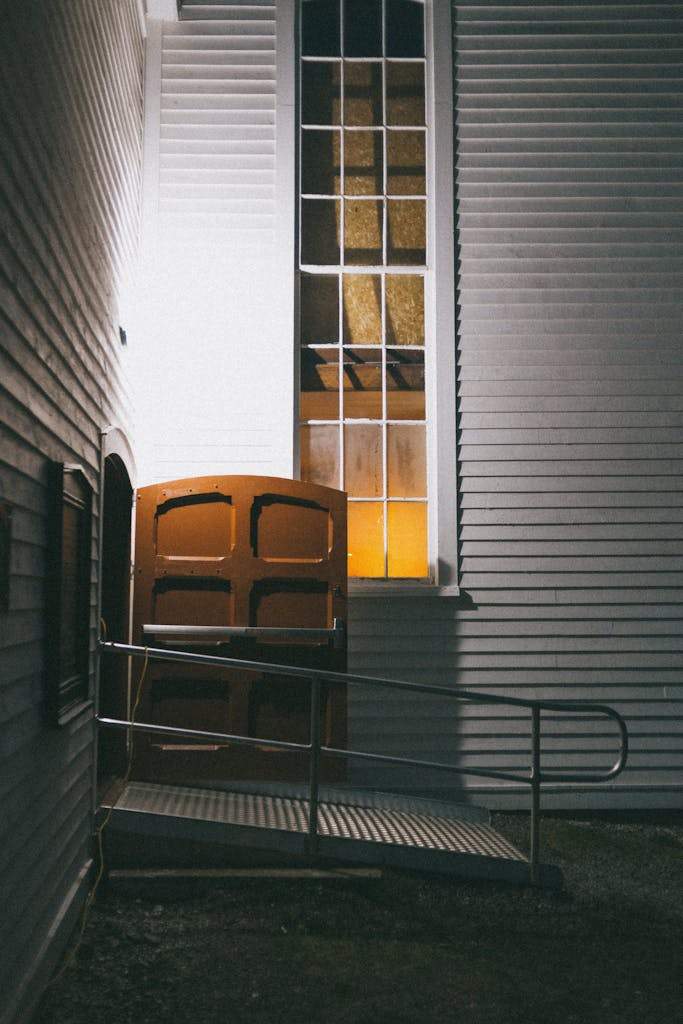
Steps at the entry are the most common and potentially most serious entryway hazard. Entryway ramp ideas for seniors and step solutions range enormously in cost, permanence, and the mobility levels they serve.
Handrail Installation and Improvement
The most affordable, most impactful step modification is a properly installed handrail, and it is the right first step for any senior who can still navigate stairs safely but benefits from support.
Many homes have a single handrail on one side of the entry steps. This addresses grip support on the dominant side but leaves the other side unsupported. For seniors with bilateral weakness, post-surgical recovery, or advanced arthritis, handrails on both sides of every staircase – exterior and interior – provide better support than a single rail.
Specifications that matter for senior use:
- Rail should run the full length of the staircase from top to bottom, with returns at each end (horizontal sections that prevent a hand from sliding off)
- Graspable diameter: 1.25–1.5 inches, which is the ADA-specified range for functional grip
- Material: Metal or hardwood that can be gripped fully in wet or cold conditions. Vinyl and painted wood can become slippery when wet.
- Anchoring: Posts and wall brackets must be anchored to structural elements, not just surface cladding
Test any existing railing explicitly: grip it firmly and apply lateral and outward force. A railing that moves under pressure provides false security. Replace or re-anchor any railing that is not completely solid.
Cost: $200–$600 per side for professional handrail installation on a standard 3–5 step entry. $400–$1,000 for both sides with quality materials.
Threshold Ramps: Addressing Small Lips Without Construction
Best threshold ramps for seniors solve a specific, common problem: door thresholds with a raised lip of 1–4 inches that catch cane tips, walker wheels, and shuffling feet. This is the entry modification most people overlook because the threshold seems small, until it isn’t.
A threshold ramp is a wedge-shaped ramp, typically rubber or aluminum, that creates a gradual incline from the floor level to the threshold height and back down, eliminating the abrupt step. These install without construction, and some use adhesive backing, while others sit in place by weight.
Threshold ramp specifications for senior use:
- Slope: No steeper than 1:8 (for threshold heights up to 3 inches). Steeper slopes are difficult to navigate safely with a walker.
- Material: Rubber threshold ramps are less slippery than aluminum in wet conditions; aluminum is more durable for high-traffic entries
- Non-slip surface: Required on any threshold ramp because smooth surfaces become hazardous when wet
- Width: Should match the full door width so walker wheels and cane tips always contact the ramp, not the edge
Cost: $20–$80 for rubber threshold ramps. $40–$150 for aluminum models. No installation required for most designs. This is the highest-value-per-dollar home entryway modification for seniors available for entries with small threshold lips.
Portable and Prefabricated Ramps: The Middle Ground
For entries with 2–6 steps (approximately 14–42 inches of rise), a portable or modular ramp provides full step elimination without the cost, permanence, or permitting requirements of poured concrete construction.
Portable folding ramps are single-panel ramps that unfold to bridge a step or threshold. They are most appropriate for occasional use (a visiting senior, a temporary recovery period) or for entries with a single step. For regular daily use over multiple steps, a more permanent modular system is appropriate.
Modular aluminum ramp systems are the most practical middle-ground solution for most home entrance modifications for seniors. They consist of standardized platform and ramp sections that bolt together without concrete, can be installed in a single day, and can be reconfigured or relocated if circumstances change. Quality modular systems from National Ramp, EZ-Access, and AmeriGlide are widely used in residential settings and available through CAPS-certified contractors and medical supply distributors.
Ramp slope requirements: The ADA standard for accessible ramps is 1:12 – for every 1 inch of rise, the ramp requires 12 inches of run. A 3-step entry with 21 inches of total rise requires a minimum 21-foot ramp run. Many residential entries don’t have that linear footage available, which is why entryway ramp ideas for seniors often include switchback designs (ramp changes direction at a landing platform) that achieve the required length within the available space.
Cost for modular aluminum ramp systems:
- Single step (6–8 inches): $300–$600 installed
- 2–3 steps (12–21 inches): $800–$2,000 installed
- 4–6 steps (24–42 inches): $1,500–$4,000 installed
Zero-Step Entry: The Gold Standard for Long-Term Access
How to make a no-step entry for elderly homeowners – creating a path from parking or street to the home’s entry with no steps at all – is the most comprehensive entryway modification for aging in place available, and the one most recommended by occupational therapists for seniors with progressive conditions or those planning for long-term accessibility.
A zero-step entry (also called a no-step entry or step-free entry) can be achieved through several approaches depending on the home’s specific grade:
Grading and site work: If the land surrounding the entry can be graded (soil regraded to create a gradual slope to the door level), a zero-step entry can often be achieved with landscaping and walkway reconstruction. This is the most aesthetically seamless solution because it looks like a designed feature, not an accommodation.
Permanent concrete ramp construction: Where grading alone is not sufficient, a poured concrete ramp integrated into the entry hardscape creates a durable, attractive zero-step approach. When designed thoughtfully, a concrete ramp with appropriate handrails and a covered entry looks intentional and adds property value.
Entry platform addition: Adding a raised platform at the exterior door level, with a gentle ramp approach from grade, creates a zero-step entry that works with the existing door threshold height.
Cost for zero-step entry creation:
- Simple grading and walkway reconstruction: $2,000–$6,000
- Concrete ramp construction (professional, full design): $4,000–$12,000
- Complete zero-step entry with covered porch, lighting, and handrails: $8,000–$20,000+
This is the most significant investment in the home entryway modifications for seniors category, but for seniors with progressive conditions or those planning a 10–20 year aging-in-place horizon, it is frequently the right one.
Door Modifications: What Gets Missed After the Steps Are Addressed
Once the steps are addressed, the door itself introduces a second set of barriers that home entryway ideas for seniors frequently overlook.
Door Handle Replacement
Round door knobs require grip and twisting, and that is the precise motor action most affected by arthritis. Every exterior door should have a lever-style handle that operates with a simple push down, requiring no grip or rotation.
Lever handles are available in every finish and style – oil-rubbed bronze, brushed nickel, matte black, polished brass – that coordinate with any home exterior. The security hardware (deadbolt, latch mechanism) is unchanged; only the handle design differs. For seniors with significant arthritis or reduced grip strength, this $75–$250 modification changes the daily experience of entering and exiting the home immediately and completely.
Cost: $75–$250 per door, professionally installed including hardware and labor.
Door Width
Standard exterior doors are 36 inches wide, meeting the functional minimum for walker and wheelchair clearance. If your primary entry door is narrower (some older homes have 32-inch or 30-inch entry doors), widening to 36 inches requires framing work but is typically straightforward in a non-load-bearing wall section.
If you’re installing a ramp to the front entry, confirm the door width before finalizing the ramp design. A well-designed ramp that terminates at a door too narrow for a wheelchair has not solved the access problem.
Cost for doorway widening: $700–$2,500 depending on wall construction.
Door Weight and Closing Speed
Heavy exterior doors, which are common in older homes with solid wood construction, are difficult to open and hold open while simultaneously managing a cane, walker, or groceries. Automatic door openers (push-button powered operators, similar to those used in commercial buildings) are available in residential models and can be installed on most standard exterior doors.
For lower-budget solutions, adjusting the door closer speed (most commercial-style closers are adjustable) or replacing a spring closer with a slower pneumatic model reduces the force required to hold the door open during entry.
Cost: $20–$60 for door closer adjustment or replacement. $600–$1,500 for automatic door opener installation.
Door Threshold
Even after addressing exterior steps, the door threshold (the raised strip at the base of the door frame) introduces a final trip hazard. Most exterior thresholds are 1–2 inches high. For most ambulatory seniors, a threshold ramp (covered above) is the appropriate solution. For wheelchair users, a threshold modification to reduce the lip height or a threshold that adjusts to nearly flush may be required.
Walkway and Approach Modifications
The path from the parking area or street to the entry door is as important as the entry itself, and it is where many falls occur before anyone reaches the steps.
Surface Condition and Non-Slip Treatment
Cracked concrete, uneven pavers, tree-root disruption, and steep slopes on approach walkways are all fall hazards that entryway modifications in aging-in-place plans should address. A senior navigating an uneven walkway while using a cane or walker is at risk before reaching the first step.
Solutions:
- Crack repair and leveling: Concrete caulk for minor cracks; professional resurfacing or replacement for significant damage
- Non-slip treatment: Applied coatings (SureCrete, SANI-TRED) that increase traction on smooth concrete or stone surfaces
- Paver relaying: Sunken or tilted pavers professionally releveled to create a consistent walking surface
Cost: $200–$2,000 for walkway repair and treatment depending on scope and length.
Lighting
The AARP HomeFit Guide specifically identifies exterior pathway lighting as a priority home modification for older adults, and it is among the lowest-cost, highest-impact home entrance modifications for seniors available.
What adequate entry lighting requires:
- Motion-activated pathway lighting along the full walk from parking to entry door, which illuminates automatically as the person approaches, eliminating the need to navigate in darkness
- Entry door lighting that illuminates the door handle, threshold, and immediate entry area, as a lit entry makes key insertion, threshold navigation, and package retrieval safe at any hour
- Step lighting for any steps that remain after modification, either wall-mounted lights at step height or in-tread LED lighting that illuminates the step surface directly
Cost: $50–$200 for motion-activated pathway lights and entry lighting. $100–$400 for step lighting installation. Full professional exterior lighting upgrade: $500–$2,000.
Covered Entry
A covered entry or porch roof over the immediate entry area solves two problems simultaneously: it keeps the entry surface dry (eliminating wet-surface slip risk), and it provides a sheltered space to manage keys, packages, and mobility aids before stepping inside.
If a covered entry doesn’t currently exist, adding a small roof overhang over the door costs $1,500–$5,000, depending on size and materials. This is an investment that also improves the home’s visual appeal and weather protection for the door itself.
Lighting, Security, and Convenience at the Entry
The final category of entryway modifications for aging in place addresses the convenience and security features that affect daily use without fitting neatly into the safety modification framework.
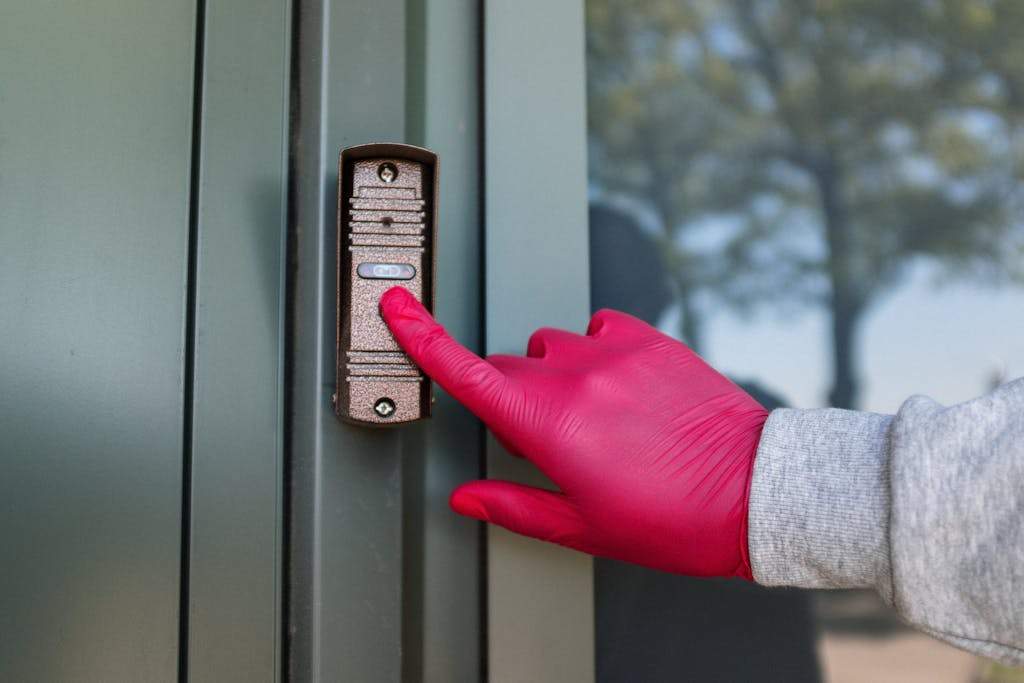
Video Doorbells
A video doorbell allows the homeowner to see and speak with visitors at the door without getting up from any room in the house, via a smartphone or smart display. For seniors who have limited mobility, who are cautious about opening the door to strangers, or who frequently miss deliveries, a video doorbell provides both safety and convenience.
The installation is straightforward, as most video doorbells replace a standard wired doorbell with no new wiring required. Setup requires a smartphone or tablet, which a family member can handle at installation.
Cost: $100–$300 for the device. Professional installation: $50–$150 if preferred.
Smart Locks and Keyless Entry
Smart lock keypads eliminate the need to find and insert a key, replacing it with a numeric code that can be entered with one hand, no grip required. For seniors with arthritis, reduced hand dexterity, or vision that makes key alignment difficult, a keypad lock is a meaningful daily improvement.
Smart locks also allow family members or caregivers to enter without a key, and can be set to automatically lock after a specified time, which is useful for seniors who may forget to lock the door.
Cost: $100–$300 for quality keypad smart locks. Professional installation: $50–$100.
What to Do With This Information: Practical Next Steps
- Walk every entry you use and document what you find before contacting any contractor. Measure threshold heights, count and measure steps, test handrail stability, and walk the approach in both daylight and reduced light. This assessment drives every modification decision and prevents the most common error: addressing one hazard while leaving others unaddressed.
- Start with threshold ramps and handrail improvements today. Both are available without professional help, cost under $300 combined for most entries, and address the two most common acute entryway hazards. Order a threshold ramp that matches your threshold height and install it the same day. Test any existing handrail and address instability immediately.
- Contact a CAPS-certified contractor for a site assessment before planning any ramp or zero-step entry construction. The right solution for a multi-step entry depends on available space, grade, structural conditions, and the homeowner’s specific mobility needs. A CAPS professional can evaluate all of these and recommend the most effective approach for your specific entry.
- Explore VA benefits and state assistance programs before committing to out-of-pocket costs for major work. Veterans may qualify for SA or SHA grants covering zero-step entry construction and ramp installation. Many states operate Medicaid HCBS programs and local home modification assistance programs that cover entry work for qualifying seniors. Contact your local Area Agency on Aging before spending significantly on entry modification.
- Replace round door knobs with lever handles on all primary entry doors. This $75–$250 modification per door delivers an immediate improvement in daily function for anyone with reduced grip strength or arthritis, and requires only a standard screwdriver and 20 minutes per door. Do this in conjunction with your entry assessment.
- Plan entry modifications alongside the complete home safety evaluation. Our aging-in-place home assessment guide covers every room and every entry point, so your entryway modifications connect to a comprehensive whole-home safety plan rather than being addressed in isolation.
When to See a Specialist
For threshold ramps, handrail testing, and door handle replacement, these are DIY-appropriate modifications that don’t require professional involvement for most homeowners.
For any construction work like modular ramp installation, zero-step entry construction, doorway widening, or permanent concrete work, two professionals are worth engaging:
A licensed occupational therapist (OT) assesses your specific mobility needs against the entry’s characteristics and produces a modification recommendation based on your actual functional abilities, not just your current condition. This is especially valuable for seniors with progressive conditions where modification needs will change over time.
A CAPS-certified contractor executes the modifications with aging-in-place design knowledge and not just standard construction knowledge. The difference matters: a ramp built to the wrong slope, a zero-step entry that creates pooling water at the door, or a handrail at the wrong height all solve the visible problem while creating new ones.
A Note for Family Members and Caregivers
The entry modification conversation is often easier to initiate than bathroom or bedroom safety discussions, because “the steps are getting harder” is something a parent will often acknowledge openly, even when they minimize other safety concerns.
When helping a parent address entry modifications, start with the simplest changes that can be made immediately: threshold ramps, handrail testing, door hardware replacement, and lighting. These visible, concrete improvements often open the door (literally and figuratively) to conversations about larger modifications.
If a parent is resistant to a ramp, frame it as an option rather than a necessity: “We can put in a modular ramp that can come back out if you don’t want it there. Let’s try it for a month.” The reversibility of modular systems makes this offer genuinely honest.
For broader guidance on supporting a parent through home modification planning, including handling resistance and coordinating professional assessments, see our resources on [building a care and support system].
The Bottom Line on Entryway Modifications for Aging in Place
Entryway modifications for aging in place span from a $25 threshold ramp to a $15,000 zero-step entry construction, and the modifications that address the most acute risks are at the lower end of that range.
Start with threshold ramps and handrail assessment. These two changes address the most common acute entry hazards for under $300 combined. Add door handle replacement, pathway lighting, and approach surface repair as near-term improvements. Plan larger work like ramp systems or zero-step entry construction, etc., with a CAPS professional who can evaluate your specific entry against your specific needs.
The most important principle: the entry to your home is not a detail. It is the daily boundary between home and the world. Home entryway ideas that make this boundary easier to cross safely, independently, on your own terms, are some of the most meaningful investments available in any aging-in-place plan.
Your next step: Before finalizing any entryway work, make sure you have a complete picture of your home’s full modification needs. Download our free Aging in Place Planning Checklist, it covers every entryway element alongside every other room, giving you a complete prioritized action plan to work from.
Every time you leave home and return to it on your own terms, that independence is worth protecting — and the right entryway modifications make sure it stays that way.