The bathroom remodel was nearly finished when the contractor realized the problem. The new shower was beautiful, tiled, curbless, exactly what the homeowner had asked for. But the entry opening was 32 inches wide. The wheelchair was 25 inches wide. The chair barely fit through the opening, but there was no room to maneuver inside, no space to transfer, and no way to close the glass door once the chair was in position. They had built an accessible shower that wasn’t actually accessible.
That scenario is more common than it should be. Roll-in shower design is specific, dimensional, and unforgiving. A shower that misses the turning radius by six inches, positions the controls on the wrong wall, or slopes the floor in the wrong direction isn’t a minor inconvenience; it’s a barrier that defeats the purpose of the renovation entirely.
This guide covers every element of roll-in shower design for wheelchair users: ADA-required and recommended dimensions, drain placement and floor slope, fixture positioning, transfer considerations, material selection, and realistic cost ranges. By the end, you’ll know exactly what a properly designed roll-in shower requires, what questions to ask your contractor, and what specifications to insist on before work begins.
What Makes Roll-In Shower Design Different From Standard Accessible Design
Roll-in shower design is a specific category within accessible bathroom design, and it is more demanding than general accessibility modification. Understanding why helps you evaluate contractor proposals and catch design errors before they become expensive mistakes.
A standard curbless walk-in shower, which is the most common aging-in-place bathroom modification, eliminates the step-over threshold. That single change dramatically improves safety for ambulatory seniors with balance or mobility limitations. But a curbless shower designed for a standing user is not the same as a roll-in shower designed for a wheelchair user. The difference is in the dimensions, the turning space, the fixture placement, and the floor slope, and getting any one of those wrong produces a shower that a wheelchair user cannot safely or comfortably use.
A roll-in shower is specifically designed so that a wheelchair can enter, maneuver, position for transfer or bathing, and exit without the user needing to stand at any point. That functional requirement drives every design decision: the opening must be wide enough for the chair plus maneuvering clearance, the interior must provide a turning radius sufficient for repositioning, the controls must be reachable from a seated position without requiring a reach across the body’s midline, and the floor must drain without creating slope hazards for the wheelchair’s wheels.
ADA roll-in shower design standards, established by the U.S. Access Board, provide the minimum dimensions that a roll-in shower must meet in covered public and commercial facilities. For private residences, ADA standards are not legally required, but they represent the most thoroughly tested, most widely vetted set of dimensions available for this application, and they are the appropriate benchmark for any residential roll-in shower design.
According to the U.S. Census Bureau, approximately 2.7 million Americans use wheelchairs, and the prevalence of wheelchair use increases significantly with age. For the full context of how roll-in shower design fits within a comprehensive aging-in-place bathroom plan, see our complete guide to bathroom modifications for aging in place here.
The Complete Roll-In Shower Design Specifications
Opening Width: The First and Most Critical Dimension
The shower entry opening is where most roll-in shower design errors occur, and where they are most expensive to fix after the fact.
ADA minimum clear opening width for a roll-in shower: 60 inches. Read that again. Not 60 inches of total shower width – 60 inches of clear opening at the entry point.
This is the dimension that surprises most contractors who haven’t built roll-in showers before. Standard accessible shower designs reference 36-inch doorways. Roll-in showers are fundamentally different: the 60-inch opening allows a wheelchair to enter, maneuver, and position for a transfer without requiring the user to back in awkwardly or perform tight maneuvers in a confined space.
For residential applications where a full 60-inch clear opening is not structurally feasible, a minimum 36-inch clear opening can accommodate a roll-in entry if and only if the interior provides sufficient maneuvering space (covered in the turning radius section below). However, the 60-inch opening is the design standard because it works. The 36-inch minimum is a constrained accommodation that requires compensatory design elsewhere.
What this means for your bathroom: The roll-in shower opening is typically achieved by removing the shower door entirely (using a shower curtain instead) or by using a wide-opening sliding door system. Glass panel doors with standard hinges are almost always too narrow and do not accommodate the clearance required for wheelchair maneuvering.
Interior Dimensions and Turning Radius
ADA roll-in shower design specifies two interior dimension configurations:
Standard roll-in shower configuration: 36 inches deep × 60 inches wide minimum. This configuration requires the 60-inch clear entry opening noted above. The 36-inch depth provides sufficient space for a wheelchair user to position parallel to the shower wall for transfer. The 60-inch width provides maneuvering room.
Alternate roll-in shower with seat: 36 inches deep × 60 inches wide, with a fold-down or fixed shower seat at one end of the 60-inch wall. This is the most functional configuration for wheelchair users who transfer to the seat for bathing; the wide-end positioning allows approach from multiple angles.
For independent wheelchair users who remain in the chair during bathing (a less common but legitimate use case), interior dimensions should allow a complete 180-degree turn. A standard manual wheelchair requires approximately 60 inches of turning diameter. A power wheelchair may require 67–80 inches depending on the model. Confirm your specific wheelchair’s turning radius before finalizing interior dimensions.
For residential projects where space is constrained: The minimum acceptable residential roll-in shower for most wheelchair users is 36 inches × 36 inches with a 36-inch clear entry, but this is a genuine constraint that limits maneuverability. Work with a licensed OT who has assessed the specific user and their specific chair before accepting dimensions below the ADA standard.
Floor Slope and Drain Placement
Floor slope is where roll-in shower design gets technically specific and where errors create genuine safety and usability problems.
The requirement: A roll-in shower floor must slope toward the drain to evacuate water, but the slope must be gentle enough that a wheelchair rolls smoothly without the user fighting lateral drift.
ADA maximum slope for roll-in shower floor: 1:48 (approximately ¼ inch per foot). This is shallower than a standard shower’s 1:32 slope. The shallower slope is required because a steeper pitch causes wheelchair wheels to track toward the low point of the floor, creating a force the user must constantly counteract, exhausting and potentially unsafe.
Drain placement options for roll-in shower design:
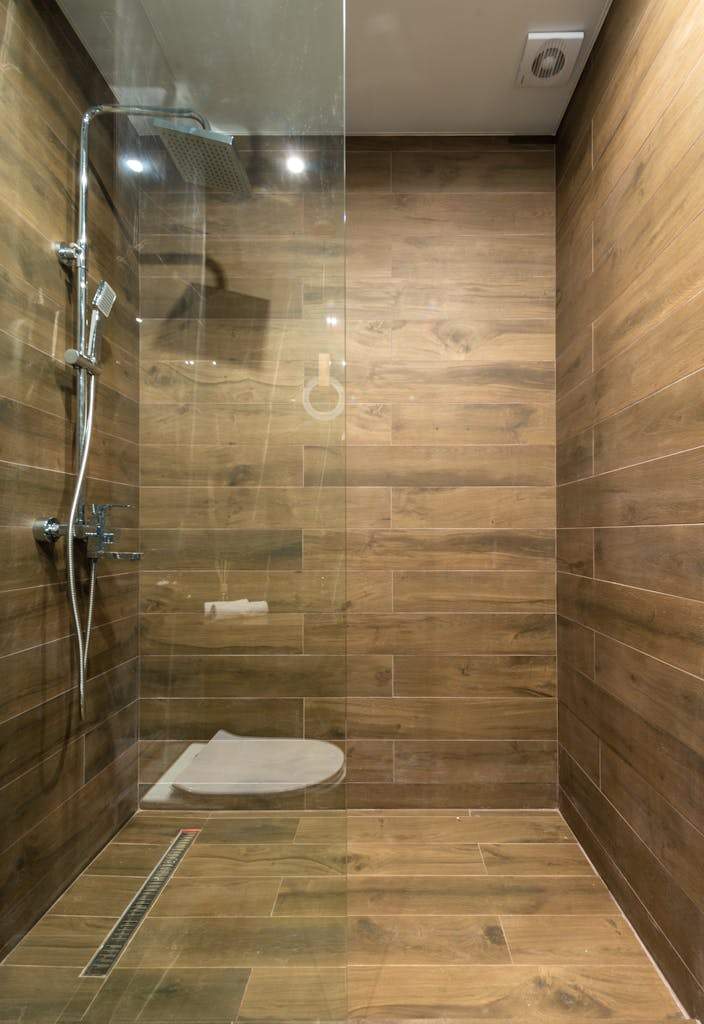
Linear drain at the entry threshold: The most effective solution for wheelchair accessibility. A linear drain running the full width of the shower entry point collects water before it can run toward the wheelchair’s positioning area. The floor slopes uniformly toward this single linear drain from the rear wall, keeping the majority of the shower floor relatively level. This is the preferred configuration for wheelchair accessible roll-in shower design.
Corner drain: A traditional center-drain design can work in a roll-in shower if the slope is gentle and uniform. Corner placement with a 1:48 slope from all four walls is functional. Still, it requires precise execution; uneven tile installation or inconsistent slope creates drainage problems that are difficult and expensive to correct after the fact.
Center drain: The least preferred option for roll-in shower design because the four-directional slope creates constant lateral pressure on the wheelchair. Avoid center drains in roll-in shower design where possible.
Grab Bar Placement: Roll-In Shower Specific Requirements
Grab bar placement in a roll-in shower design for wheelchair users differs from standard shower grab bar placement because the primary use case is not fall prevention during standing; it is transfer support and positioning assistance.
For transfer-based shower use (wheelchair to shower seat):
- Transfer side wall: A horizontal grab bar at 33–36 inches from the floor on the wall adjacent to the shower seat’s transfer side. This is the primary grab bar for the transfer movement
- Rear wall: A horizontal bar at 33–36 inches extending across the full rear wall (minimum 24 inches, ideally 36–42 inches) for repositioning support while seated
- Control wall: A vertical bar at 18–22 inches from the shower controls, positioned for stability while adjusting water temperature and flow
For users who remain in the wheelchair during bathing:
- Grab bars are less critical for the bathing process itself but remain important for any partial standing transfers or position adjustments
- The rear wall bar serves as a stability reference point during maneuvering
Critical installation requirement: Every grab bar must be anchored to wall studs or solid blocking, never to tile or drywall alone. In a roll-in shower conversion where walls are being opened for tile work, this is the optimal time to install continuous blocking (a solid wood panel behind the tile board) across the full height and width of all shower walls. This allows grab bars to be placed anywhere on any wall surface without structural constraint. The incremental cost during an active renovation is minimal; the cost of opening a tiled wall to add blocking later is substantial.
Shower Seat Design: Fixed vs. Fold-Down
Most wheelchair-accessible roll-in shower designs include a built-in or wall-mounted shower seat, not because wheelchair users always transfer out of their chairs to bathe, but because having a seat available significantly expands the range of bathing options and care scenarios.
Fold-down wall-mounted seat: The standard recommendation for most roll-in shower designs. Folds flat against the wall when not needed, freeing floor space for full wheelchair maneuvering. Must be anchored to studs or blocking with a rated load capacity of 250 lbs minimum. Teak and teak-style materials resist moisture well and are visually attractive. ADA seat dimensions: 15–16 inches deep, 17–19 inches from the floor.
Fixed L-shaped or corner seat: Provides a larger seating surface and is structurally more robust. Reduces available floor space, which is a meaningful tradeoff in a shower at minimum ADA dimensions. Best suited for showers with adequate interior dimensions to accommodate both the fixed seat and full wheelchair maneuvering.
The transfer position: A properly designed seat allows a wheelchair to approach parallel to the seat, with the wheelchair positioned so the seat and the wheelchair seat are at approximately the same height. This side-transfer approach is the standard technique recommended by occupational therapists. Seat height of 17–19 inches accommodates most adult wheelchair seat heights. Confirm against the specific user’s chair seat height before finalizing.
Fixture Placement: Controls, Showerhead, and Reach Zones
Controls and fixtures that a standing user reaches easily become inaccessible to a seated wheelchair user if positioned without deliberate planning.
Shower controls (thermostatic valve and on/off):
- ADA placement: Controls on the control wall (the wall perpendicular to the shower seat), positioned 38–48 inches from the floor
- Critical positioning rule: Controls must be reachable without requiring the user to lean across the water stream to adjust temperature, position controls on the same side as the shower entry or the seat transfer side, not the opposite wall
- Thermostatic mixing valve: Strongly recommended for wheelchair users preset to a safe maximum temperature, preventing scalding from sudden hot water delivery while the user is unable to quickly move away
Showerhead placement:
- Handheld showerhead on adjustable slide bar: Required, not optional, for a functional roll-in shower. The handheld allows directed water flow to any area without the user needing to reposition. The slide bar should span from seated height (approximately 48 inches) to standing height (approximately 72 inches) for caregiver-assisted bathing flexibility.
- Fixed overhead showerhead: Can be included as a secondary fixture, but should not be the primary fixture in a roll-in shower design. An overhead-only shower in a roll-in design creates a situation where water is always running over the entry area uncomfortable for anyone entering or adjusting controls.
Reach zone for seated wheelchair users: According to the U.S. Access Board, the maximum comfortable side reach from a seated wheelchair position is 48 inches high and 24 inches to the side. All controls, soap dispensers, towel bars, and fixtures should fall within this zone. Anything outside it will be awkward or inaccessible.
Flooring Material: Traction Meets Wheelchair Roll Resistance
Roll-in shower flooring must balance two competing requirements: sufficient traction to prevent slipping (for any standing users or caregivers) and low enough rolling resistance for wheelchair use.
Best options:
- Matte or honed tile (12×12 or larger): The most widely recommended surface for wheelchair roll-in showers. Matte finishes provide traction without the texture ridges of smaller mosaic tiles that create resistance and vibration for wheelchair wheels. Larger tiles mean fewer grout lines. Grout lines perpendicular to the direction of wheelchair travel create repeated small bumps that are fatiguing over distance.
- Large-format porcelain tile: Durable, moisture-resistant, available in matte and textured finishes. 24×24 or 18×18 tiles minimize grout line frequency.
- Linear mosaic tiles (1×1 or 2×2): High traction but high grout line frequency, acceptable for the wet zone immediately under the showerhead but not ideal across the full roll-in surface.
Avoid: High-gloss polished tile (slippery when wet), heavily textured stone surfaces (high rolling resistance), and standard non-slip bath mats (create uneven surfaces that can catch wheels).
Roll-In Shower Cost: What to Budget
Roll-in shower cost is higher than standard curbless shower conversion costs because of the dimensional requirements, the specialized drain systems, and the higher precision required for slope execution.
Realistic roll-in shower cost ranges for US residential projects (2025):
- Basic roll-in conversion (prefabricated base, standard fixtures, fold-down seat): $5,000–$9,000 installed
- Mid-range tile roll-in shower (custom tile, linear drain, proper blocking, handheld showerhead, fold-down teak seat, thermostatic valve): $9,000–$16,000 installed
- Premium accessible roll-in shower (custom tile throughout, heated floor, designer linear drain, full blocking package, premium fixtures): $16,000–$25,000+ installed
What drives cost at each level:
- Linear drain systems add $500–$2,000 over standard drain configurations
- Full-wall blocking (allowing any-location grab bar installation) adds $500–$1,500 during active renovation, far less than the cost of opening a tiled wall later
- Thermostatic mixing valves add $300–$800 over standard valve configurations
- Structural work (widening doorways, relocating plumbing, addressing load-bearing walls) adds cost that is highly site-specific. Budget $2,000–$8,000 for significant structural modifications
Funding options: Veterans may qualify for VA SAH or SHA grants covering accessibility modifications. Some state Medicaid HCBS waiver programs cover roll-in shower conversions for qualifying individuals. Contact your local Area Agency on Aging for programs available in your state.
For a complete breakdown of all aging-in-place modification costs and funding sources, see our guide to aging-in-place remodeling costs here.
What to Do With This Information: Practical Next Steps
- Get a professional assessment before contacting contractors. A licensed occupational therapist (OT) who specializes in wheelchair accessibility can evaluate your specific bathroom, your wheelchair dimensions and turning radius, and your transfer technique and produce a written specification that contractors can bid against. This prevents the most common and expensive roll-in shower design errors. Ask your physician for an OT referral, or contact your local AAA.
- Confirm your wheelchair’s specific dimensions before any design is finalized. Standard ADA dimensions accommodate most manual wheelchairs. Power wheelchairs and bariatric chairs may require larger turning clearances and wider openings. Measure your chair: seat width, overall width, turning radius, and seat height. These numbers drive every critical dimension in the design.
- Hire a CAPS-certified contractor with documented roll-in shower experience. A general contractor who has never built a roll-in shower will apply standard accessible shower knowledge and miss the roll-in-specific requirements. Ask specifically: how many roll-in showers have you built, and can I speak with a previous client? Find CAPS professionals at nahb.org/caps.
- Request a written design specification before any work begins. The specification should include: interior dimensions, opening width, drain type and placement, floor slope, blocking locations, fixture heights, and seat dimensions. A contractor who cannot or will not provide a written specification before work begins is not the right contractor for this project.
- Plan the wider bathroom layout at the same time. A properly designed roll-in shower is only fully functional if the bathroom approach also accommodates wheelchair maneuvering. The bathroom entry doorway (36-inch minimum), the turning space in front of the shower (60-inch diameter minimum), and the toilet transfer space should all be evaluated as part of the same renovation plan. Our aging-in-place remodeling checklist covers the full bathroom layout requirements.
When to See a Specialist
A licensed occupational therapist (OT) should be involved in any roll-in shower design project before a contractor is hired. The OT assessment establishes the specific dimensional requirements based on the individual user’s wheelchair, transfer technique, and physical capabilities information that no general specification can provide.
For projects involving structural modifications (widening doorways, relocating plumbing, addressing load-bearing walls), a licensed architect with accessibility specialization should review the structural drawings.
Questions to bring to your OT assessment:
- Based on my specific transfer technique and wheelchair, what are the minimum interior dimensions my roll-in shower needs?
- Where should the shower seat be positioned relative to my wheelchair approach, and at what height?
For broader guidance on the healthcare professionals involved in aging-in-place planning, see the complete guide to aging in place here.
A Note for Family Members and Caregivers
If you are coordinating a roll-in shower installation for a parent or loved one, the single most important thing you can do before any contractor conversations is involve the wheelchair user themselves in the design decisions. Seat height, grab bar placement, control positioning, and approach direction are all affected by the individual’s specific transfer technique, and that technique is deeply personal and often highly practiced.
A design that works perfectly for one wheelchair user’s transfer approach may not work at all for another’s. The occupational therapist assessment should include the wheelchair user actively demonstrating their current transfer method so the design can accommodate it precisely.
For guidance on coordinating complex home modification projects for a parent, including managing contractor relationships, handling family disagreements about scope and budget, and prioritizing when resources are limited, see our resources on [building a care and support system].
The Bottom Line on Roll-In Shower Design
Roll-in shower design is one of the most technically specific and most consequential home modifications available, and the most common errors are dimensional ones that could have been caught with proper planning.
The non-negotiables: a minimum 60-inch clear entry opening where structurally feasible, a maximum 1:48 floor slope toward a linear drain, grab bars anchored to blocking installed during construction, and controls positioned within the seated wheelchair user’s reach zone. Miss any of these, and the shower may function, but not for its intended purpose.
Work with an OT and a CAPS contractor who has built roll-in showers before. Get the specification in writing. And plan the full bathroom layout, not just the shower, as a single accessible system.
Your next step: Before finalizing any design decisions, conduct a complete bathroom accessibility assessment using our aging-in-place home assessment guide. It covers every element of bathroom accessibility, not just the shower, so your roll-in design works within a fully accessible bathroom rather than as an isolated upgrade.
Designing this right the first time is an act of real care, and with the right team and the right specifications, it is entirely achievable.